
Kevin Clarke
Operetta
21 March, 2026
The Bühne Burgäschi has announced a new production of Hopsa for summer 2026, bringing renewed attention to the work with which composer Paul Burkhard laid the foundation for his international career in 1935.
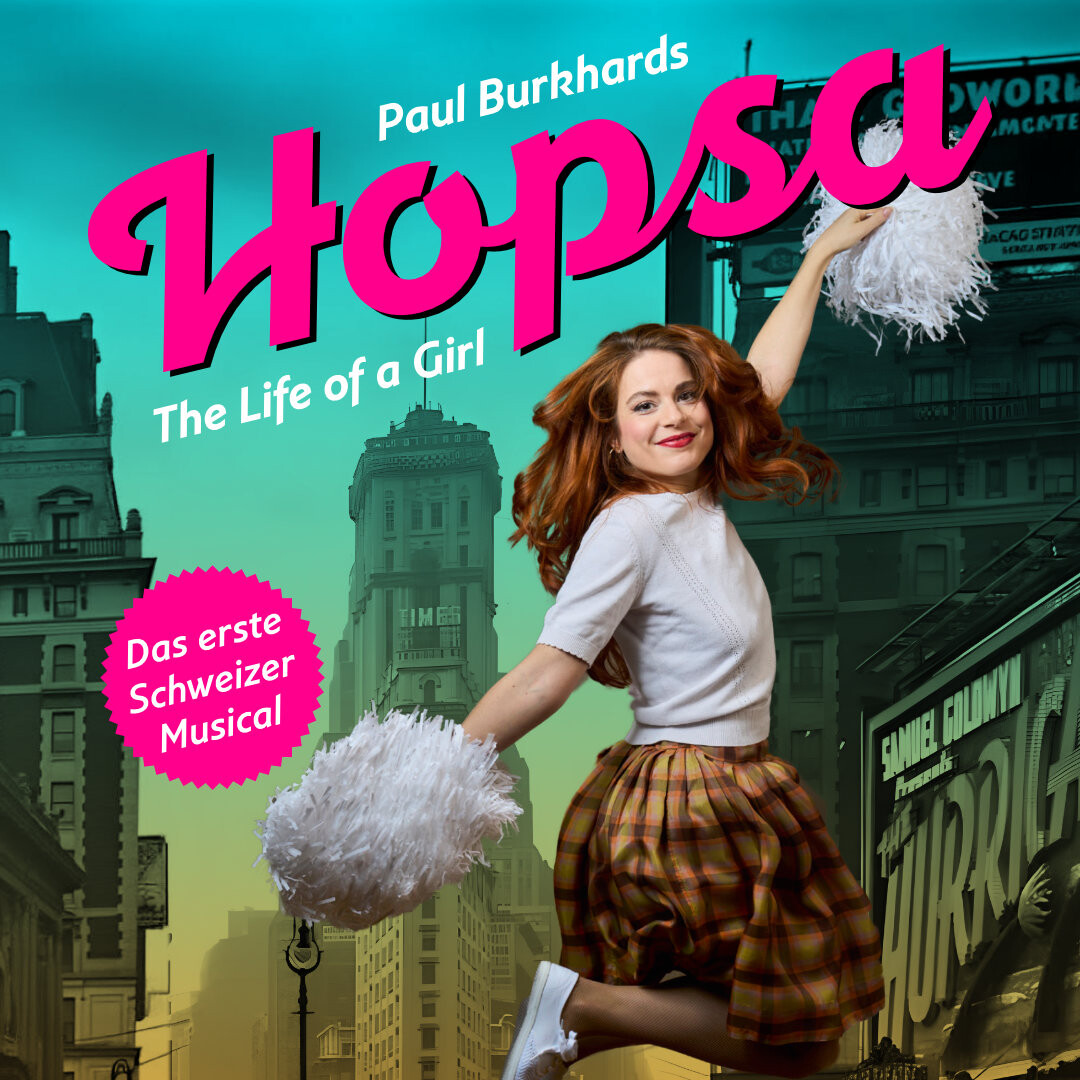
Poster for the “Hopsa” production of 2026. (Photo: Bühne Burgäschi)
Premiered at the Opernhaus Zürich, the musical—based on a work in two acts (twelve scenes) by Armin L. Robinson and Paul Baudisch, with lyrics by Robert Gilbert—became an immediate success. Almost overnight, Burkhard was celebrated as a major new voice in musical theatre.
Contemporary critics recognized the remarkable achievement of the then 24-year-old composer. The Neue Zürcher Zeitung praised the work as the product of an individual and highly skilled artist, noting Burkhard’s confident command of both refined jazz idioms and lyrical melodic writing. His music was described as elegant, rhythmically assured, and rich in expressive charm.
Formal Innovation
At the time of its creation, Hopsa represented a formal innovation. Although labeled a “revue operetta,” the work is clearly structured according to the two-act musical format, complete with prologue and epilogue. This hybrid conception was no coincidence: Robinson, intent on renewing the operetta genre, had taken Burkhard on a study trip to Paris and London, where the composer encountered contemporary developments in musical theatre. The result was not only Burkhard’s first stage work, but also what can be considered the first Swiss musical.
The story centers on Hopsa, the nickname of Mary Miller, an orphan from the small American place called Wiggletown. She is being trained at a girls’ institute to become a teacher, while secretly in love with her childhood friend Bill, a physical education instructor. Bill, however, initially believes himself to be in love with Gloria, a theatre-obsessed young woman who has little interest in marriage and instead longs for adventure. She persuades him to leave school and elope with her to New York.
Hopsa follows them as a stowaway on the train. In New York, Gloria secures a minor role as the fourteenth chorus girl in a revue. Hopsa, by contrast, is discovered by an ambitious director, who recognizes her talent and transforms her into a revue star. Meanwhile, Bill struggles to find his place, working as an usher.
A shift in fortunes within this Wiggletown trio on Broadway ultimately leads to a heartfelt resolution: Hopsa relinquishes her star position to Gloria and returns with Bill to a quiet rural life—bringing the story to its own “happy end.”
A new version of Hopsa will be presented by Bühne Burgäschi in summer 2026. Performances will take place between 18 June and 5 July 2026 at the Hornusserhaus Oekingen.
For more information and cast details, click here.