
Gerrit Waidelich
Operetta Research Center
24 October, 2026
Since 1992, artistic director Michael Garschall has been presenting complete operetta productions in his home community of Blindenmarkt, Lower Austria. This year, for the first time, he has chosen his favorite operetta by Franz Lehár, Der Zarewitsch (The Tsarevich).
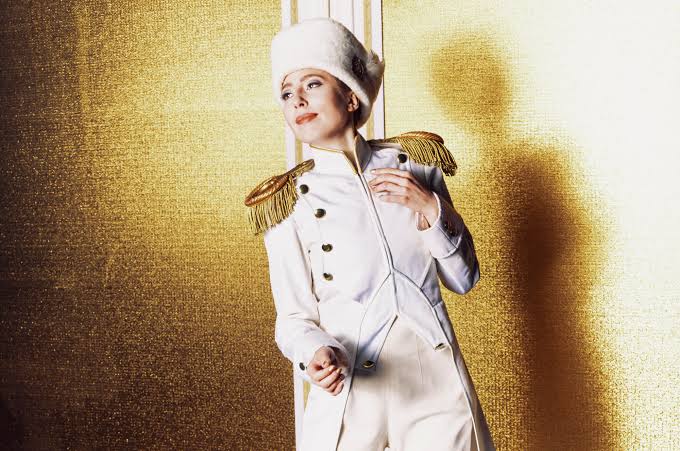
Maja Triler on the poster of “Der Zarewitsch”. (Photo: herbsttage.at)
The author of the original dramatic source was the Polish writer Gabryela Zapolska (1857–1921). She had initially made her name as a highly successful actress, and the numerous plays she wrote around the turn of the twentieth century enjoyed considerable popularity throughout much of Europe. Nevertheless, the plot of Der Zarewitsch was initially met with resistance. During the First World War in particular, Russia, Germany’s neighbor, seemed an unfamiliar and alien world to German-speaking audiences. Following the play’s premiere at Vienna’s Volkstheater in 1917, with Raoul Aslan in the title role, one dismissive review stated: “On the whole, the erotic piquancy of this work derives from the machinations surrounding a perverse prince who is transformed into a conventional husband; the result is a rather uninteresting piece of women’s writing.” Critics of the play suspected that the tsar’s son was either impervious to the advances of the fair sex or even averse to them.
The initially critical reception of Zapolska’s play did not deter librettists Bela Jenbach and Heinz Reichert from proposing the subject to Lehár ten years later and adapting it to suit his musical intentions. The first version of his operetta premiered in 1927 at Berlin’s Deutsches Künstlertheater. It was not until 1928 that the work received its Viennese premiere at the Johann Strauss Theater. When the revised version appeared in 1937, the authors—the composer and librettists—explicitly instructed “the gentlemen directors” to use only this version from then on.
In the first version of the operetta, Lehár specified in considerable detail the dance styles that inspired his vocal numbers, including a One-Step and a dance evolution by the Grand Duke with a women’s chorus, Tempo di Valse, Sonja’s tango, a Boston waltz, foxtrot, ballet, Charleston, hymn and Marcia maestoso. In the definitive version, he left these references implicit: the same rhythms are still heard, but they are no longer specifically identified in the score’s headings.
A stroke of good fortune
The lengthy dialogues in the original libretto—which the librettists intended to prescribe every detail of the staging—have been condensed by Wolfgang Dosch, a director thoroughly at home in the operetta genre, to around a quarter of their original length. Nothing essential is omitted; instead, the audience is spared much of the ponderous padding characteristic of the 1920s and various supposedly amusing historical embellishments. This not only benefits the performers but also serves today’s audiences, who primarily come to enjoy the qualities of Lehár’s score and the production’s visual and theatrical appeal.
One aspect of this staging is particularly striking: the official Russian state apparatus keeps a watchful eye on the heir to the throne and all his movements. It is hardly surprising, then, that his opportunities to develop freely as an individual are restricted or even denied. The Grand Duke may boast of his numerous erotic experiences and adventures, but the Tsarevich himself has had no access to such pleasures until his passion is awakened by and for Sonja. The enormous red cloak of the future tsar hangs like a tent at the center of the stage, a constant reminder that the Tsarevich must be ready to put it on at any moment.
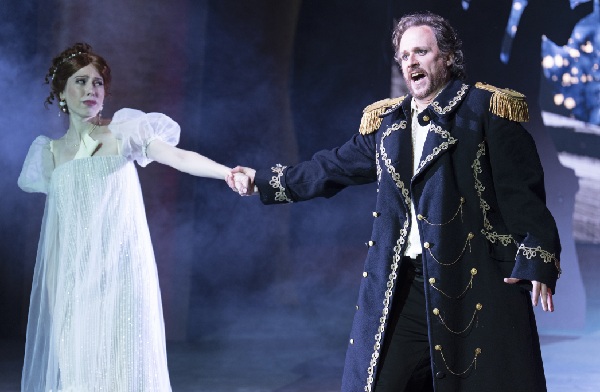
Maja Triler and Clemens Kerschbaumer in “Der Zarewitsch” at Herbsttage Blindenmarkt. (Photo: Lukas Beck)
All the operetta’s popular numbers are delivered with great relish at the Herbsttage festival: “The Soldier on the Banks of the Volga” (Der Soldat am Wolgastrand), “Rock Me, My Darling” (Schaukle, Liebchen), “Someone Will Come” (Einer wird kommen), “Alone, Once Again Alone” (Allein, wieder allein), “A Woman, You a Woman” (Ein Weib, du ein Weib), “I Have Only You Alone … You Are Heaven to Me!” (Hab’ nur dich allein … Du bist der Himmel mir!), “Tonight I’ll Come to You” (Heute Abend komm’ ich zu dir), “My Burning Heart Belongs to You Alone, My Beloved!” (Mein brennendes Herz gehört nur dir ganz allein, Herzgeliebte, du bist mein!), “We Circassians Need Neither Land nor Money” (Wir Tscherkessen brauchen weder Gut noch Geld), and “Caressing Waves / Why Does Every Spring Have Only One May?” (Kosende Wellen / Warum hat jeder Frühling, ach, nur einen Mai?).
Director Dosch is entirely right to praise the music for its “great emotions and passion, its inexhaustible wealth of melodies and tonal colours. What Lehár uses in a single operetta becomes the life’s work of some musical-theatre composers.” The Herbsttage chorus, children’s chorus, ballet, children’s ballet and studio performers are all showcased to excellent effect in the choreography by Monica Rusu-Radman.
In the Ybbsfeld Chamber Orchestra, the strings and, in particular, the woodwinds play with great precision and a rich, expressive sound under the musical direction of Thomas Böttcher. Both gently lyrical passages and more energetic sections are beautifully realised. Kurt Dlouhy, who for decades served as the Herbsttage festival’s accomplished musical director, is now responsible solely for the chorus, which he has prepared exceptionally well. All the performers on stage appear thoroughly at ease, thanks in part to the excellent preparation of musical director Thomas Langhammer.
Make-up artist Anna Maurer enhances the performers’ natural appearance to excellent effect. Lighting designer Lukas Siman has tailored his concept ideally to the limitations of the relatively small stage and the practical set by Marcus Ganser. Ganser has created a kind of corridor stage, with side curtains and a rear backdrop displaying distinctive, largely abstract motifs and changes of coloured lighting alongside the watchful eye mentioned above. Russia is bathed in dark red, while Italy is rendered in pale blue. The overall visual design is equally convincing. For the female dancers, headpieces that might otherwise resemble fur hats have been cleverly replaced with airy fringes. The costumes are by Julia Pschedezki.
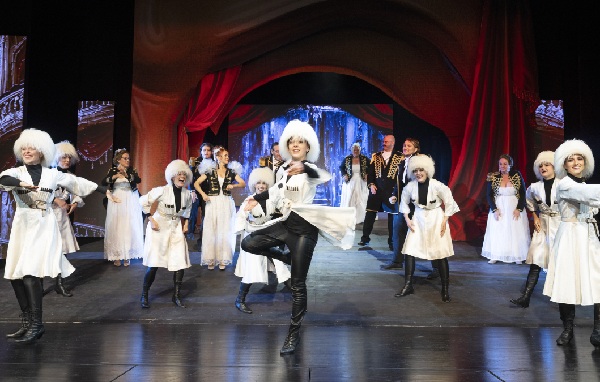
Scene from “Der Zarewitsch” at Herbsttage Blindenmarkt. (Photo: Lukas Beck)
The production’s particular strengths are most evident in the principal performers engaged by Garschall. Rebecca Moellers, as Sonja, commands the stage with outstanding presence. Her pleasantly clear diction combines with a bell-bright voice and graceful appearance. Her soprano is beautifully controlled throughout its range, making her an excellent choice for youthful lyric roles in both opera and operetta. She is equally assured and expressive in the spoken dialogue, and moves with such agility that her portrayal of a dancer is entirely convincing. However, even when dressed as a Circassian in the ballet’s ostensibly all-male group, she does not project an androgynous quality—although the role does not require one.
Clemens Kerschbaumer makes his debut in the role of Aljoscha, associated with Richard Tauber. The part is richly rewarding for singers, both melodically and vocally. Perhaps Lehár was, in his own way, paying tribute to his Italian friend, who had died in 1924. Kerschbaumer’s voice, with its rather masculine, dark timbre, can soar into luminous heights in pianissimo—even when he is lying on the floor. His diction, in both singing and dialogue, is equally clear, ensuring that no detail of the text is lost. This Tsarevich, supposedly “the enemy of all things feminine”, is very much a womaniser, even if he must first learn how to become one in the course of the story. Certainly, no conversion therapy is required. The fact that he has equipped his room for self-discipline and physical training with a camp bed and exercise apparatus is discreetly suggested.
Andreas Sauerzapf (Ivan) and Katrin Fuchs (Mascha) form a tried-and-tested duo whose performances have been ideally matched for years. They transcend the usual clichés of the comic couple, and Sauerzapf’s physical agility is demonstrated when he throws in a double cartwheel. Long associated with the Herbsttage festival, Fuchs excels for the first time in the coquettish soubrette role of Mascha. Ivan and Mascha’s duets are charged with erotic innuendo—“Darling, try it with me once more!”—much like those of Josef and Pompadour in Leo Fall’s operetta of the same name from 1922, with its suggestive line about her making him feel “quite Potiphar-like”.
Mascha and Ivan also reflect wittily on the consequences of their marriage within this social setting. They are convinced that marriage is not a crime, but perhaps a punishment—an allusion to Dostoevsky that is already present in the original. The libretto’s more piquant lines, such as “I think the little rascal is a girl” and “Why don’t I remember that you’re a man?”, are not unnecessarily emphasised. References to shifts in gender roles—subjects that Hofmannsthal and Strauss also explored with relish in works such as Der Rosenkavalier and Arabella—remain as charmingly understated as the flirtatious allusions to Cherubino in Mozart’s The Marriage of Figaro.
In Dosch’s production, the Grand Duchess—portrayed with convincing warmth, kindness and strength of character by Kammerschauspielerin Marianne Nentwich—tries to bring a little humanity and maternal affection to the heartless machinery of the tsar’s court. Here the director has made a small dramaturgical adjustment: unlike in the original, the role of stern enforcer of the law is assumed by the prime minister, played with crisp diction by Janos Mischuretz.
The performers were rewarded with enthusiastic applause at the end of the performance. This is exactly how operetta can, should and deserves to be presented: a thoroughly enjoyable experience for audiences and connoisseurs alike!