
Annegret Gertz and Kevin Clarke
Operetta Research Center
26 December, 2025
Stage director and choreographer Giorgio Madia discusses operetta then and now, with a special focus on the Mörbisch festival years during which he worked with Harald Serafin and defined a special style of performance which many people around the world consider “classic”.
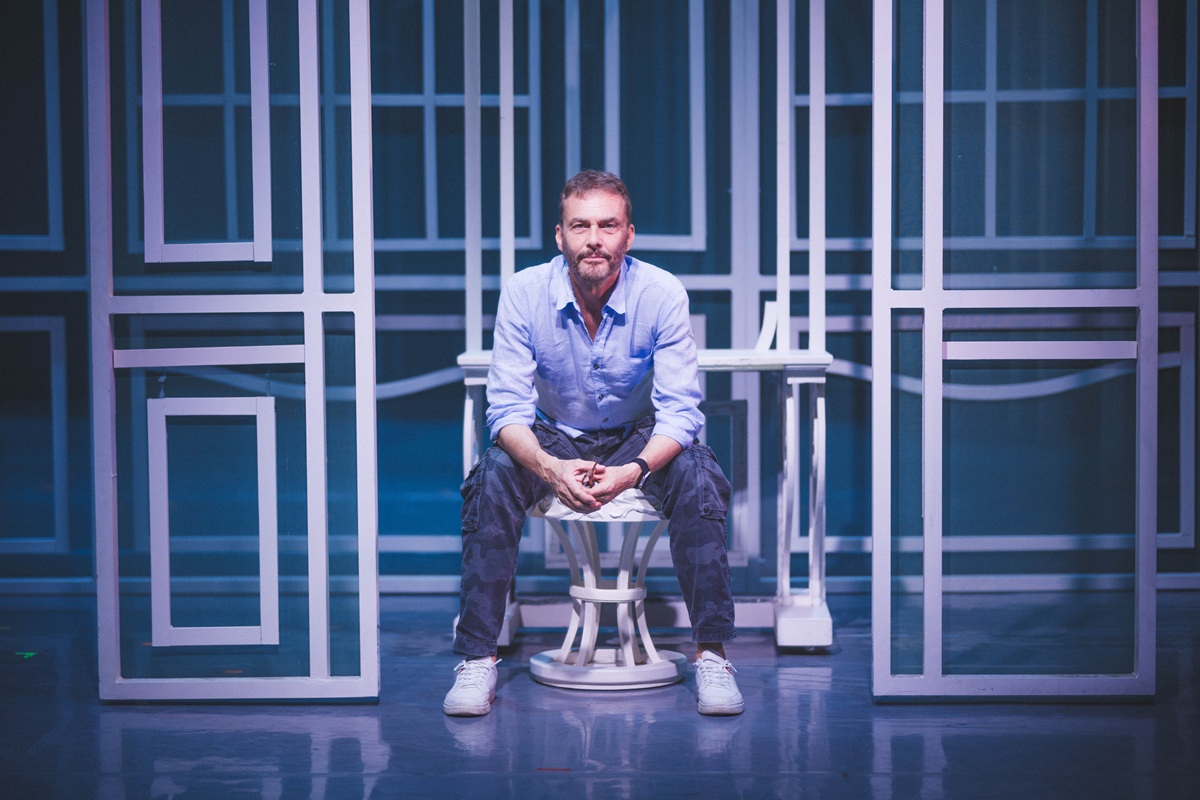
Choreographer and stage director Giorgio Madia. (Photo: Rasmus Kull)
Italian choreographer and stage director Giorgio Madia has worked in the field of operetta with companies in Vienna, Mörbisch, Baden, Dresden, Leipzig, St. Petersburg, but also in Lodz and in Tartu (Estonia). Together with the artistic team of the Mörbisch festival in the era of Harald Serafin era he created a particular “operetta style” from 2002 to 2012 that became internationally famous via TV broadcasts and DVD releases. For many this particular “look and sound” became synonymous with the genre itself. Before becoming involved with operetta, Madia received his training as a classical dancer at the ballet school of La Scala in Milan, joined the Scala Ballet ensemble, but, fascinated by Maurice Béjart’s theatrical approach of the “Spectacle totale”, joined Béjart’s Ballet du XXième Siècle for five years. In his career he has been a Principal Dancer in the USA, Italy, Switzerland, or on the world tour with Rudolf Nureyev. He started to create his own choreographies in 1995. He’s directing operetta, musicals, opera and full-evening length ballets to the present day.
Do you still remember your first encounter with operetta?
Yes, as a kid I saw Italian versions of operettas in black and white TV productions. I liked the easy-on-the-ear tunes and found the stories highly entertaining.
If you were a child in 1970s Italy, liking operettas was probably not considered particularly cool by your classmates.
(laughs) I was always listening to “strange” music, from jazz and old folk songs to French chansons. I was collecting all the vinyl discs that nobody wanted anymore in our household. I never listened to the conventional pop music of the day. Classical music was constantly around our house because my mother had been a concert pianist before getting married, though she rarely played for us at home. Instead she rarely played behind locked doors because she didn’t want to be heard.
When you entered the dance world, did you ever discuss operetta with your colleagues?
It never came up, no. But by coincidence, I was chosen to participate as a dancer in a big production. In 1990, in Die Fledermaus at San Francisco Opera, I was the principal ballet dancer.
Americans have a very different tradition of performing operetta than, let’s say, Austrians or Italians. How would you describe the approach to the genre in 1990s San Francisco?
Our Fledermaus was well received because Americans – with their own showbusiness tradition – know how to put on big and spectacular productions. I was surprised by the lack of purism with regard to the Strauss score. For the act two party scene they had Bobby McFerrin on stage, and Kiri Te Kanawa came on and sang Gershwin’s “Summertime.” The audience loved it!
If you compare this experience in San Francisco with the operettas you had seen as a child on Italian TV, how would you describe the difference?
In Italy, the productions were in black and white, stylishly reduced, often with very modern costumes. In America, operetta was like a lavish Christmas spectacle in Technicolor, full of glitter and feathers.
Did you like the glitter and feathers?
I liked the “over the top” aspect, yes, but I didn’t particularly like the kitsch. What I learned was this: such a grand spectacle can be highly satisfactory for the audience.
When Americans go “over the top” in terms of show business, how is that different to Europeans?
I am struggling to remember any “over the top” productions in Europe. (laughs) It’s something most European directors shy away from for fear of not being taken seriously as artists. Americans, on the other hand, have a long tradition of celebrating such spectaculars in Hollywood, on Broadway, in pop culture in general. They are very serious about it, and they invest the greatest possible craftsmanship into it. Critics acknowledge that and don’t necessarily see it as something negative.
Do you think operetta should be “over the top”?
Of course. Every show must be “over the top,” after all, this is theatre, it needs to be bigger than life.
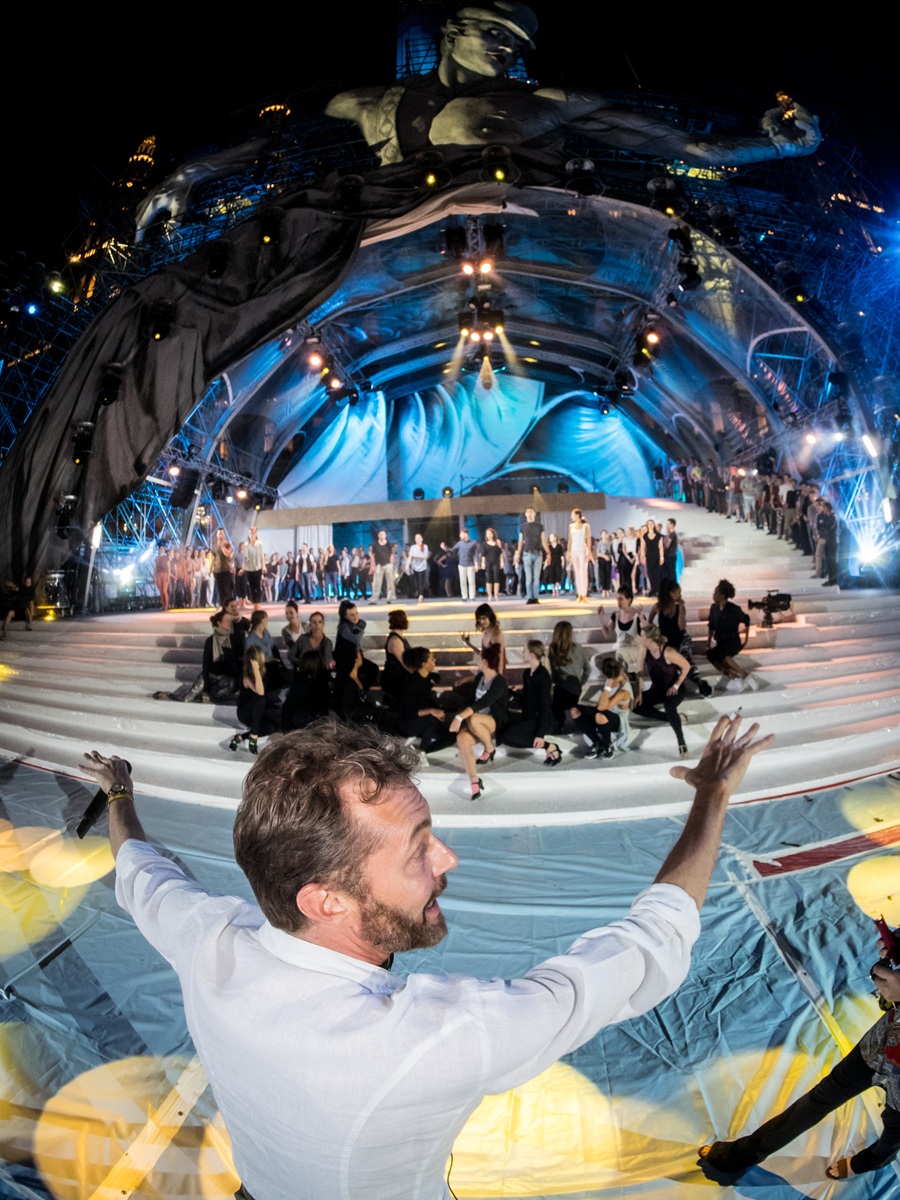
Giorgio Madia rehearsing the Life Ball in Vienna. (Photo: Ashley Taylor)
You were a dancer in this Fledermaus. Did you think that dance was an essential element of operetta at the time?
The Americans around me could all sing, act, and dance. That’s the basic training everyone in the USA gets when they go into musical theatre professionally. You see it in every Broadway musical and in every pop video, in every film and TV series. It’s a “triple threat,” and American audiences expect that when they go to a show – be it Die Fledermaus or a Las Vegas appearance by Frank Sinatra or Bette Midler.
Your next professional encounter with operetta was in 1997 in Zurich.
It happened by chance when I was ending my career as a dancer and started focussing on choreography. I was at the Zurich Opera House where my workshop performance had been well received by the audience, mostly because my work looked different from that of all my colleagues. I tried to create a “spectacle totale,” and had a tenor hanging on a swinging rope singing “La donna è mobile” while a dancer in a diamond jockstrap moved around. A lady with 50 black balloons attached to her head appeared as Medusa, while Eskimo mating sounds played. There was an overwhelming reaction to my first work as a choreographer, so the opera company offered me a job to help Helmuth Lohner with his upcoming Merry Widow production. When I asked him what his concept was, he said, with a smirk: “Boobs!”
Today, that would be considered politically incorrect, and no one would phrase it like this anymore, not even as a joke. But Lohner made me understand some essentials about operetta and The Merry Widow: it is a battle of the sexes between a man and a woman, it’s about eroticism and sensuality, a sexual provocation even if you listen to the music. And that needs to be visible too in the costumes (think of what corsets accentuate) but also in the movements on stage. Plus, everything has to be light and playful, not intellectual. (And Mr. Lohner was indeed a very intellectual person!) So in a way, he gave me a key to understand the genre.
What did you do with that “key”?
I was as stimulating and provocative as I could be, especially in the big cancan scene with the Grisettes! To have dancers on an opera house stage rip off their underwear and show their asses was, at the time, new. And Lohner loved it. So much so that he expanded the cancan scene and made it last almost ten minutes. The more outrageous my ideas were, the more he jumped on them. This worked well for me, and we ended up doing seven productions together all in all. He also took me with him from Switzerland to Austria where I worked with him at the Vienna Volksoper.
You mentioned “boobs” as Lohner’s remark about his approach to operetta. But the choreography you describe also involves other body parts – and not just females.
Helmuth Lohner was a womanizer, but he had a lot of elegance. He was a movie star and an important Burgtheater stage personality. He appreciated beauty and knew the power it can have on audiences.
So he put attractive women and men on stage, to offer something for everyone? For straights and gays?
Absolutely. But every stage director sees the world through his own eyes. Everything is viewed through their own filters.
Was the of topic hetero/homosexual audiences ever discussed?
There was actually no opportunity to have any gay elements in The Merry Widow, the characters are all coupled up in a traditional, heteronormative way. We did not have a Prince Orlovsky character à la Fledermaus. But we did have highly attractive and seductive male dancers that brought a certain element of homoeroticism to the production.
If you compare this Merry Widow in Zurich to your experiences seven years earlier in San Francisco, how would you say the approach to operetta was different?
Helmuth Lohner dared to be more outrageous. He understood the tongue-in-cheek aspect of operetta better.
I assume the soloists in Witwe were all opera singers. How did they fit into your sparkling vision of a show business world of operetta?
It’s always hard work to get classically trained singers to do something that doesn’t involve standing in the centre of the stage and singing. (laughs)
Did you arrange the showbusiness elements around them?
If you want to have an easy time, that’s the best way to do it, yes. However, I always wanted to integrate the singers into the spectacle, I would not just have a ballet troupe come on stage, dance, and leave again. That’s boring. (I realize that I did it anyway, out of necessity, but only on a couple of occasions.)
Helmuth Lohner brought you to Mörbisch with him.
Yes, he suggested my name for the choreography of an upcoming Csárdásfürstin in 2002 at the self-declared “Mecca of Operetta”: the Seefestspiele Mörbisch. They did annual operetta productions back then, with more a 100 artists on stage, including 40 dancers. They performed for a live audience of 6.500 spectators for 30 performances every season. And they had a 3.500 square metre stage.
What was your impression of Mörbisch?
I was impressed that such a huge venue could be dedicated exclusively to operetta, and that the genre was taken so seriously there. Also, there was an interesting combination of older stars and young people. They could learn about “traditions” from their elders, learn about what I’d call the “Viennese spirit” of operetta. After all, almost everyone at Mörbisch came from Vienna which is 77 kilometres away. These older people had operetta in their DNA. Only the dancers came mostly from Bratislava.

Portrait of Giorgio Madia on stage. (Photo: Parietè)
What did you learn about this DNA?
I was there when Rudolf Bibl was the conductor of all productions. He had a very special style of treating operetta music. When he conducted, the music made “sense” to me, it had an inner logic, the tempi and dynamics felt right. Then there was Rolf Langenfass as the set designer. Plus Harald Serafin as artistic director who also played many roles himself. They showed me – as the newcomer – the magic of this particular type of operetta which combined big showbiz moments with classically trained singing and lavish sets They also always respected the original stories of these pieces. There was no deconstruction. They tried to honor the intentions of the original authors. At least, that’s how I saw it. And I tried to do the same with my choreography, which had to fill this gigantic stage, as a total spectacle. So yes, the feathers and glitter helped to dazzle the eyes of the spectators. My way of handling the mass movements was inspired by American role models such as Busby Berkeley, but mixed with European elements. Plus the tongue-in-cheek approach I had learned from Lohner, which was also very much my own approach to musical theatre.Nowhere else, at the time, could you see so much dancing in operetta. It was a central element of every production at Mörbisch.
They asked me to be present in every rehearsal to treat choreographic and movement topics in case they might come up, even if those rehearsals were not purely choreographical. I believe dancing should always be central to any operetta , as dance is essential in these scores. If you read historic reviews – for example of Lustige Witwe in 1905 — critics usually point out the dance skills of soloists such as Louis Treumann, not their singing. This was lost later, and we brought it back with a bang.
The singers used microphones, which is something we know from Broadway and many musicals. In the operetta world, at the time, it was unusual.
I do not think the soloists used a different technique for singing with a microphone. They used their classical voices, but because of the outdoor setting and size of the venue, they needed amplification. Sometimes Serafin would also hire non-classical singers when he thought a piece needed that, so for Im weißen Rössl in 2008, we had Rainhard Fendrich as Leopold, someone with a pop music background. He was fantastic.
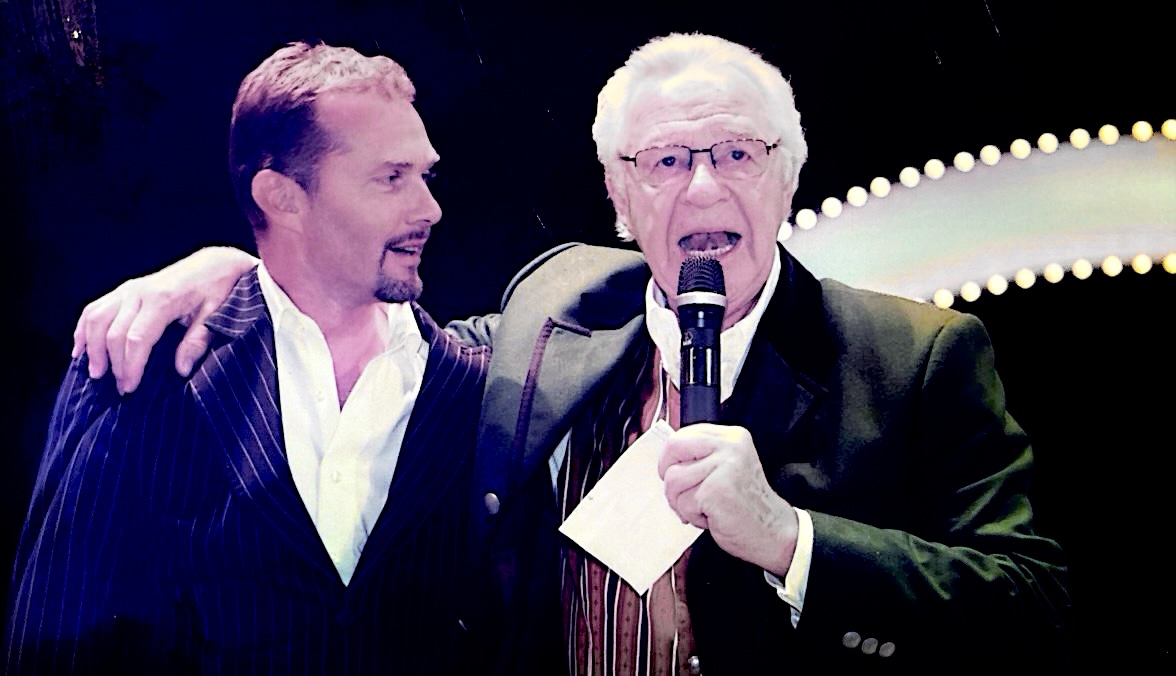
Harald Serafin (r.) and Giorgio Madia. (Photo: Private)
Mörbisch is a tourist attraction. The people who run it, behind the scenes, are from the local tourist board. How does that affect the way they chose titles?
I was told that Jacques Offenbach is ‘impossible’ in Austria. People apparently did not like him, and his works were not considered suitable for Mörbisch. Putting them on would have been too much of a risk. I do not know if that is correct or not. But the titles we selected needed to strongly resonate with our audience: if they did not know and like a particular title, they would not come and buy tickets. But we did lesser-known pieces such as Lehár’s Giuditta, and that turned out to be one of the most successful productions of my entire time there.
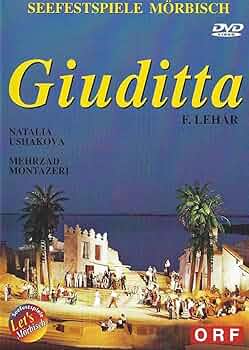
The DVD version of the “Giuditta” production at the Mörbisch festival. (Photo: Videoland)
Would you say that the style of these productions was old-fashioned?
They were not trying to be modern or contemporary. On the contrary, because of the historical context of the stories, these pieces told they aimed to be tastefully timeless. Also, we were not performing for young enthusiasts but mostly for an ocean of white-haired people in the audience with more conservative expectations.
On the other hand, all productions were broadcast on TV and released on DVD, available internationally. (I remember seeing a Mörbisch production as part of the on-board entertainment during a Lufthansa flight to New York.) So your audience was much bigger.
Harald Serafin was a great communicator, incredible with marketing and PR. There has been nothing like it since. He understood the power of the media, and he understood in a very businessman like way, that you needed to place your product well in the public eye.
Would you say Serafin’s marketing approach set Mörbisch apart from everyone else?
Absolutely. Serafin invented the slogan “Mekka der Operette,” and he was serious about it. His audience felt, instinctively, that operetta was his life, that there was total identification. He had been the Danilo of his generation. He had worked with every famous operetta personality of his era. For him operetta wasn’t a gimmick, not something you played around with for a while and then dropped again. It was his identity. He came across as “authentic.” And this rubbed off on his operetta productions.
When Serafin left, this approach to operetta stopped. Also the worldwide marketing stopped. Today, Mörbisch plays musicals like Mamma Mia and My Fair Lady. The productions are not televised anymore, nor are there DVD releases. Does that mean this type of operetta is dead, a historical relict?
I’m afraid so, and I’m sorry about this. Anyone willing to travel today to see a so-called “classic” (in its staging) operetta, has nowhere left to go.
You’re lucky that this whole era is enshrined in DVD and CD. Where do you see the historical mark that you left?
All the productions were filmed by the national Austrian TV channel ORF, yes, but sadly they were filmed really badly. All the interesting stage action and the dazzling show effects were cut out. I still have hysterical fits about this every time I watch an old DVD.
How could they miss that? Do Austrian TV people have no feeling for show business?
Their camera men and TV directors had a complete misconception of what operetta is. They wanted to do their own new staging for the camera. So the camera was always in the wrong place at the wrong time. The stagings were much more entertaining live. So, for me, these DVDs are not a real testimony for my work.
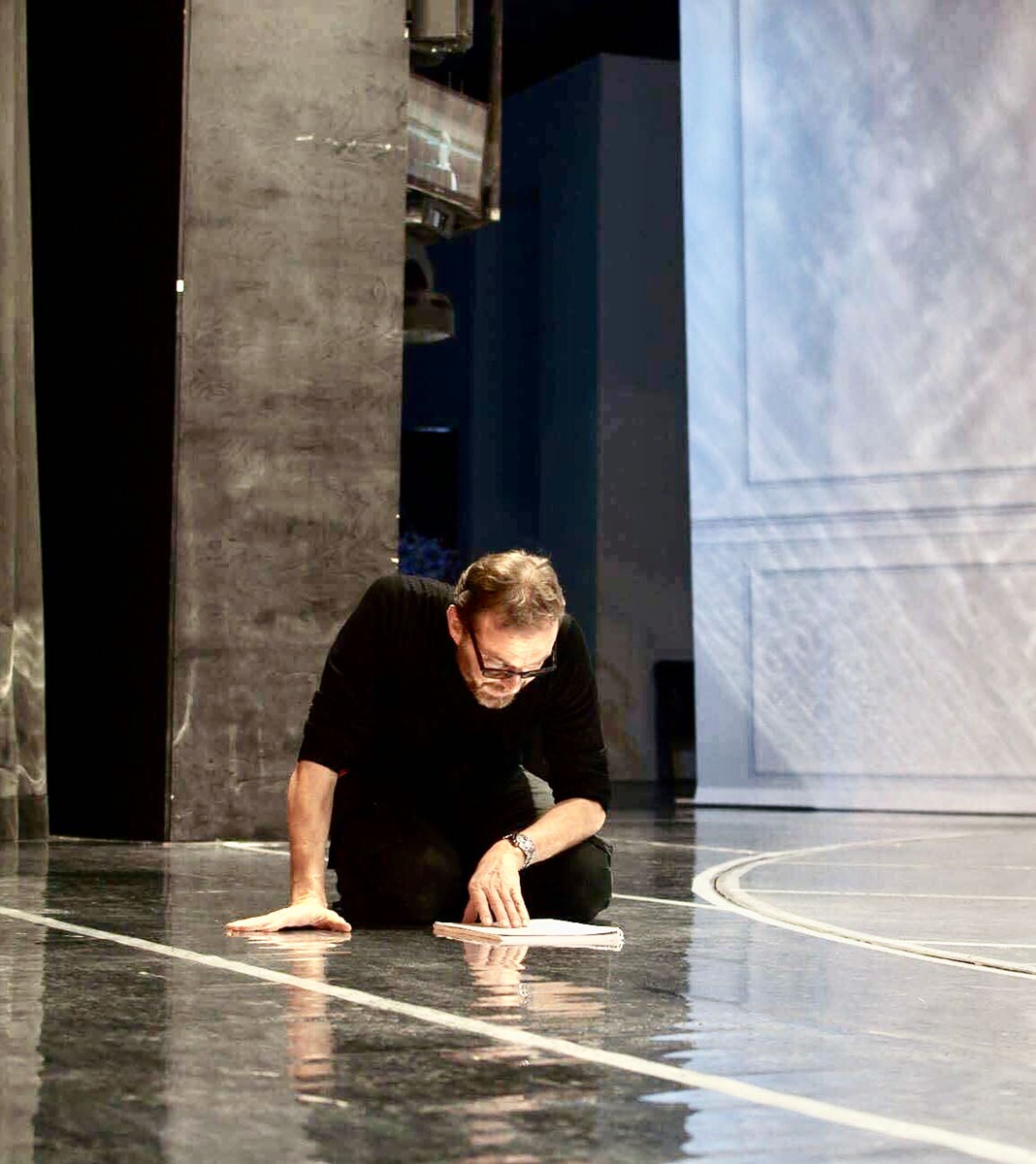
Giorgio Madia at work. (Photo: Rasmus Kull)
Today you stage operetta in many parts of the world. Is it still just a sea of white hair, or is there a new audience?
I continuously see new waves of young people interested in operetta, and in my productions, I see a good amount of younger people. I think they appreciate good entertainment more than ever before. And they are open to what operettas might have to tell them, because they are not burdened so much by traditional expectations. They approach the genre in a fresh way especially if they find something to which they can relate, be it the stories, the casting, or the performance venue. And they want to be entertained, above all else. If I do not entertain my audience, I’m not good as a director. What I do cannot just be “interesting,”, I need to be “good,” it needs excellence and sparkle. After all, young people grow up watching Disney musicals or the many other film musicals, even TikTok clips. They expect fabulous choreography, great visuals, humour, fun and tempo.
Many people in the central European theatre-scene are afraid of entertainment and fun.
Everywhere else in the world, it’s seen as a compliment if someone calls your productions “perfect entertainment,” but here it is an insult! (laughs). ). For me, as Italian, the allover perception of theatre is completely different: I grew up with Fellini movies, often on TV. My personal background and culture is totally familiar with the traditional Commedia dell’arte, its patterns are common knowledge with its grotesque and slapsticks. So, in my original cultural environment the audience is considered to see things by themselves, where “depth” is not pointed out, but many facets of poetry or even the misery of human life are shown between the lines. I like operetta to be like that too, it needs to have lightness that arises from its musical scores. When such lightness is taken away, it’s a violation of a genre. At least that’s how I see it.
You might call such lightness in the face of so much tragedy everywhere else in the world subversive … And I don’t think entertainment is ever bad. Instead, you might call it a “Menschenrecht.” Every great operetta composer and impresario knew about the importance of entertainment, and of good marketing. After all, operetta was a commercial art form: popular musical theater that needed to reach its audience to thrive. And make money. Serafin understood that. Everyone who ignores this principle is producing dead art. Sadly, you see a lot of that in today’s operetta world.
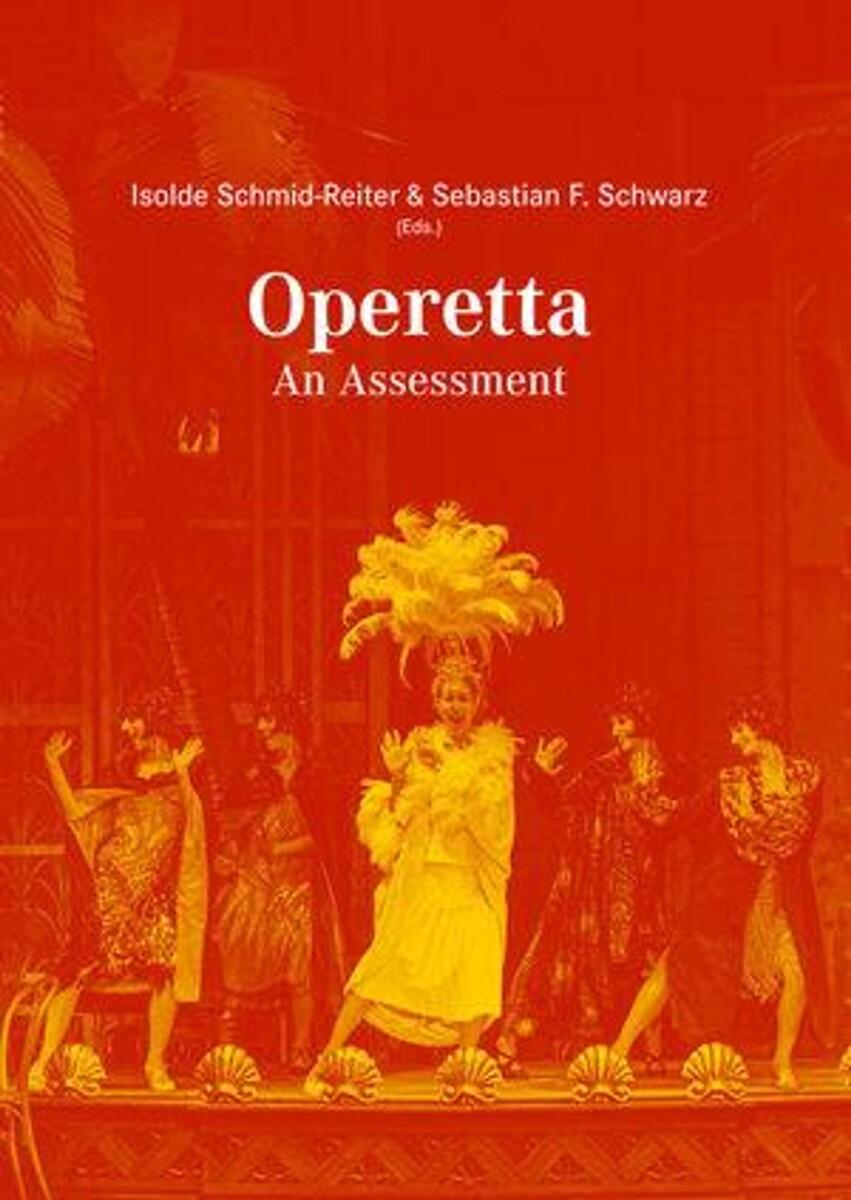
The collection of texts “Operetta – An Assessment”, edited by Isolde Schmid-Reiter and Sebastian Schwarz. (Photo: Conbrio Verlag)
Giorgio Madia is part of the new book Operetta – An Assessment, edited by Isolde Schmid-Reiter and Sebastian F. Schwarz, this interview is the longer, unpublished contribution to that project.