
Katja B. Zaich
Operetta Research Center
18 February, 2026
In the introduction to his new book “Music in the Air”. The German Musical Film Comedy in Exile 1933–1950, Helmut G. Asper describes the German sound-film operetta as a “banished genre.” It was a genre whose creators and producers—many of them German-Jewish filmmakers—were forced into exile from 1933 onward.

“Music in the Air: Die deutsche Musikfilm-Komödie im Exil 1933–1950″ by Helmut G. Asper. (Photo: Bertz und Fischer)
Although sound film had only begun its triumphant advance a few years earlier, by the early 1930s the German film industry was already well known for musical films that enjoyed considerable success abroad. This book examines which films were produced in countries of exile from 1933 onward with the involvement of émigré filmmakers. Thanks to its level of detail and completeness, the book is a veritable encyclopedia of musical film in exile.
After the introduction, the publication is divided into four major thematic sections. The first part presents a history of the German sound-film operetta and its expulsion. The second part deals with the fate of filmmakers and film productions in European exile. The third section focuses on film émigrés working in Hollywood musical, while the fourth examines musical films as they were once again produced in postwar Germany.
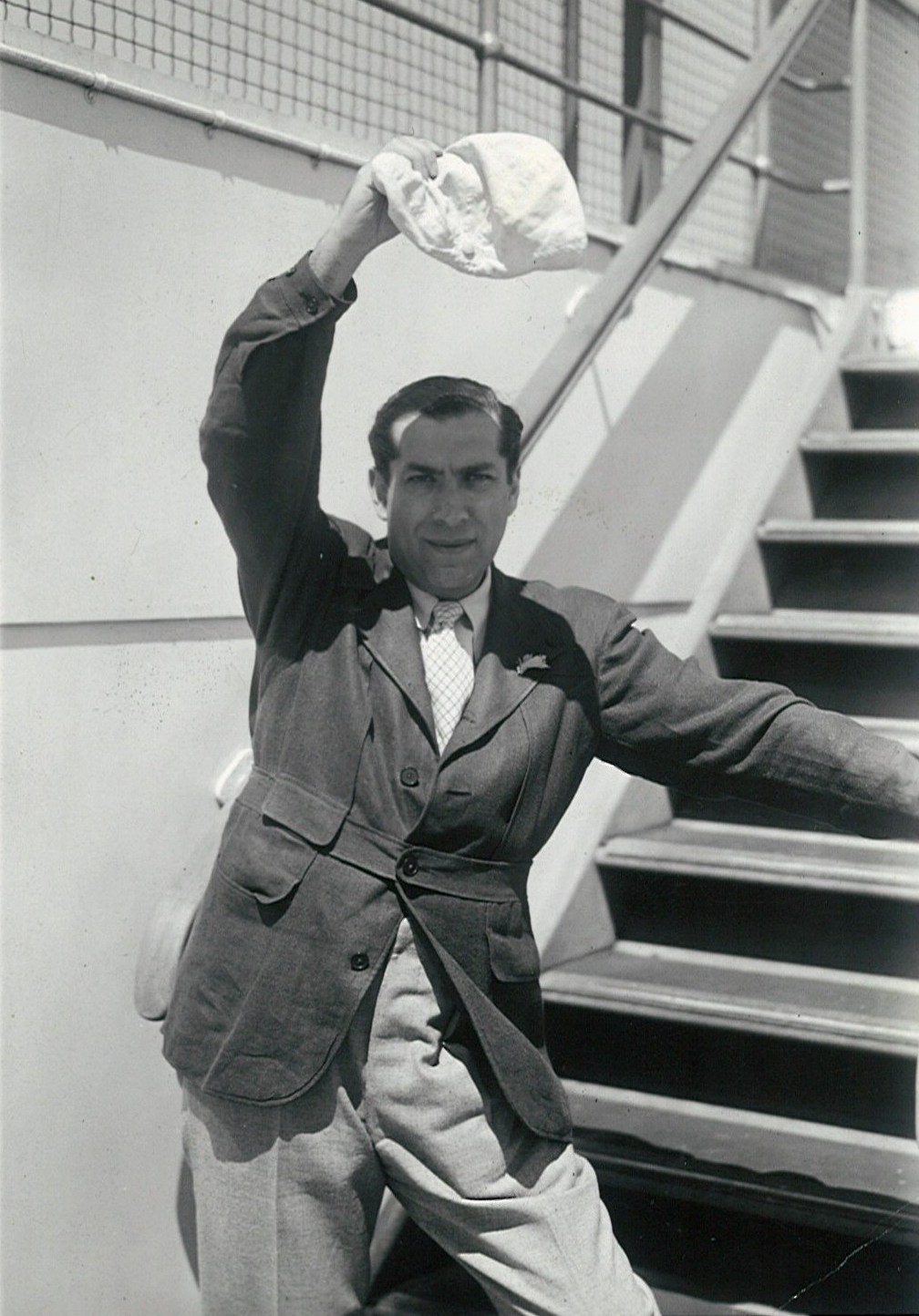
Erik Charell on board a ship to America in the late 1920s.
In the early 1930s, musical film comedies based on operetta material were regarded as a typically German form of sound film, though one that was also popular abroad. Precisely because the National Socialists considered them a representatives of the “degenerate” Weimar Republic, the representatives of this genre were among the first to suffer from anti-Jewish measures. As early as the end of March 1933, the film production company UFA began terminating contracts with Jewish employees, including well-known figures such as Erik Charell and Erich Pommer.
The book can be read as a kind of emigration history told through films, since all the films are presented individually, along with their contributors and their production and reception histories. The film titles also appear in the table of contents, making it easy to search for specific productions.
It begins with the “farewell performances” of Jewish filmmakers—the final films they made in Germany. The first destinations for many of those forced into exile were Austria, Hungary, and Czechoslovakia, where German-language films could still be produced. However, production there was financially problematic because access to the German market was denied. Moreover, anti-Jewish agitation also existed in these countries, meaning that Austria was not a suitable refuge for filmmakers long before 1938. The situation in Hungary and Czechoslovakia was simular.
The narrative then moves on to the Netherlands, where exiles helped advance the still nascent Dutch sound film industry, though ultimately only the director Ludwig Berger achieved real success. There were significantly more productions in Great Britain and France. In both countries, fear of excessive foreign influence was strong, leading to quotas on the proportion of foreign personnel involved. These quotas applied not only to directors, producers, and actors, but also to cinematographers, screenwriters, set designers, and other behind-the-scenes staff. Many of them tried their luck in several countries of exile, even in Spain, where a number of films involving émigrés were produced before the outbreak of the Spanish Civil War.
Particularly fascinating is the inexhaustible creativity with which new plots for yet another musical comedy were continually devised, or older material was embedded in new contexts, without the films becoming trivial. Thus, one learns that Billy Wilder’s famous 1959 film Some Like It Hot is based on a story by the exiled writer and actor Robert Thoeren, which had already been adapted for the screen in France in 1935 as Fanfare d’amour.
Eventually, the German musical film arrived in Hollywood along with the émigré filmmakers, where the genre was highly valued. However, the American film industry demanded absolute subordination to its preferences and production processes—something not all émigrés were willing to accept. Nevertheless, German exiles had a major influence on the Hollywood musical and, like Billy Wilder and Henry Koster, became celebrated American directors.
In the final section, Asper turns to musical films in West German postwar cinema. The genre remained popular, leading to the production of several remakes, often without consulting the original directors, who were still living in the United States.
The numerous illustrations are not printed in the book but are available via a link that can be obtained from the publisher by email. In principle, this is not a bad solution, as it allows readers to view far more photographs than could ever have been included in the printed volume. However, the link does not lead to an online platform but to a download. If one wishes to view the images while reading, one must keep the computer with the downloaded at hand at all times.