
Kevin Clarke
Operetta Research Center
9 November, 2026
Ever heard of Claude Arrieu? The French composer wrote a one-act opéra bouffe entitled La cabine téléphonique in the late 1950s. Now, more than six decades after its creation, this rarely performed work is coming to Berlin for its German premiere.
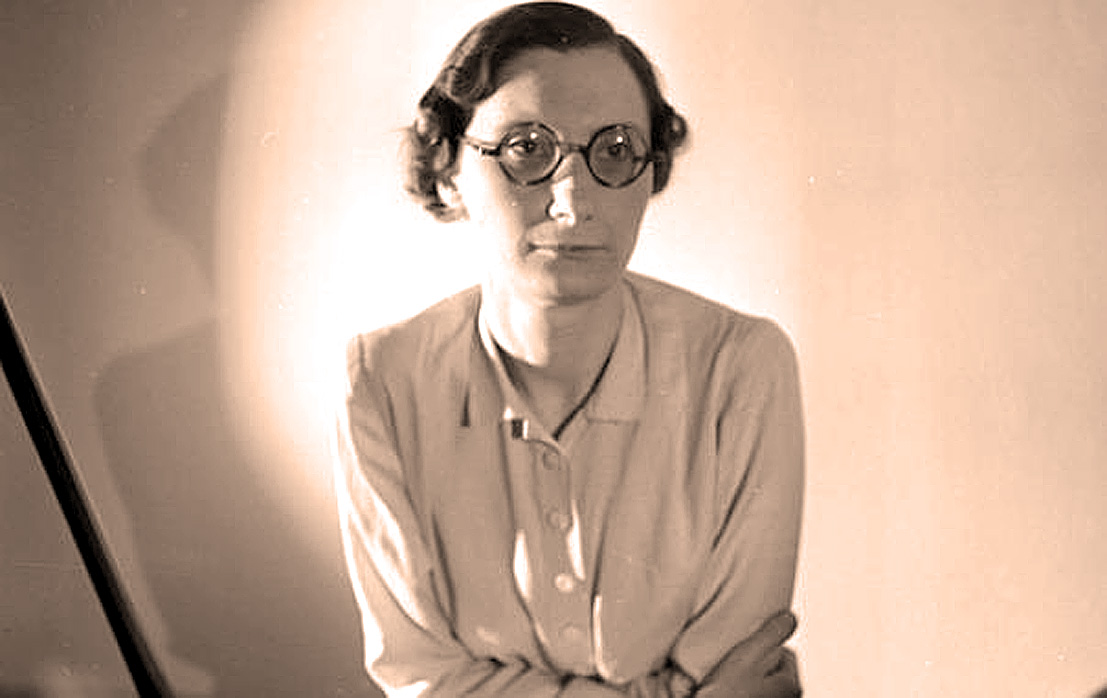
Composer Claude Arrieu. (Photo: Bru Zane Mediabase)
Originally conceived for radio, La cabine téléphonique is a witty musical comedy built around a familiar everyday situation: a young woman occupies a public telephone booth for an interminably long conversation, while five increasingly exasperated people wait outside, each convinced that they have something far more important to discuss. With considerable comic flair, the piece explores the absurdities of everyday telephone communication, misunderstandings and the growing impatience of modern life.
The cast consists of six soloists: the young woman, a sentimental lady, an old maid, a stout gentleman, an autograph hunter and a shy young man. As the various characters become increasingly desperate to use the telephone, their individual concerns collide in a series of increasingly hectic and humorous encounters.
A German premiere in Berlin
The work will receive its German premiere on 4 December as part of the concert series Die lustigen Komponistinnen (The Funny Female Composers), organised by Jazz am Helmholtzplatz e.V. The performance will take place at the Institut français / Maison de France in Berlin, in the Salle Boris Vian.

Poster for the Berlin production of “La cabine téléphonique”. (Photo: Jazz am Helmholtzplatz)
The production is directed and designed by Jasmin Solfaghari, with Aurélien Bello conducting. The leading roles include Constance Grandperrin as La jeune fille.
A prolific composer beyond conventions
Claude Arrieu (1903–1990), born Louise-Marie Simon, was one of the most prolific French composers of her generation. She chose the gender-neutral first name Claude as a professional pseudonym, partly to avoid the gender-based prejudices that women faced in the predominantly male musical establishment of her time.
Arrieu was also a lesbian, making her life and career an important part of the history of LGBTQ representation in operetta and musical theatre.
Her remarkably diverse output comprises approximately 400 works spanning almost every musical genre. She is regarded as an important representative of French Neoclassicism, particularly admired for her melodic inventiveness, sense of humor and virtuoso writing for wind instruments.
Beginning in 1924, Arrieu studied piano with Marguerite Long and composition with Jean-Jules Roger-Ducasse and Paul Dukas at the Conservatoire de Paris. In 1932, she was awarded the institution’s First Prize in Composition (Premier Prix de Composition).
Between 1935 and 1947, she worked extensively for French radio (RTF), combining the roles of composer, producer and director. This period proved particularly influential on her artistic development. She experimented with sound effects, music for radio plays and new recording techniques. Although these experiences profoundly shaped her approach to musical storytelling, she did not directly incorporate purely electronic music into her later concert scores.
Alongside La cabine téléphonique, Arrieu composed several other comic and dramatic stage works, including Cadet-Roussel (1938/1953) and La princesse de Babylone (1960).
Radio comedy meets musical virtuosity
Running approximately 30 minutes, La cabine téléphonique received its radio premiere on 15 March 1959 on French radio (RTF). The libretto was written by Michel Vaucaire, the celebrated French songwriter who also penned the lyrics to Édith Piaf’s famous song Non, je ne regrette rien.
Drawing on her many years of experience in radio and radio drama, Arrieu translates the libretto’s mounting agitation, overlapping conversations and verbal humor into a lively and sharply characterized musical score. She uses musical contrasts, rhythmic precision and increasingly complex ensemble passages to heighten the comic tension.
The instrumentation calls for a compact but colorful chamber ensemble consisting of flute, oboe, clarinet, bassoon, two trumpets, trombone, percussion and piano. The score is published by Gérard Billaudot Éditeur.
Musically, the work combines the sparkling elegance of French Neoclassicism with elements of chanson, sharp rhythmic punchlines and fast-paced ensemble scenes. As the characters compete for the use of the telephone, their voices increasingly overlap, creating a wonderfully chaotic musical portrait of everyday human impatience.
Following its 1959 radio premiere, which featured singers including Nicole Robin and Geneviève Touraine, La cabine téléphonique has occasionally found its way onto the stage, including performances at French venues such as the Grand Théâtre de Tours.
Outside France, however, the work has remained something of a rarity. Its forthcoming Berlin performance therefore offers a welcome opportunity to rediscover a witty, inventive and still remarkably relevant piece of twentieth-century French musical theatre – as well as the work of a composer whose contribution to the history of comic opera deserves considerably greater recognition.
For more information click here.