
Kevin Clarke
Operetta Research Center
19 October, 2025
What was working life like in state-owned enterprises (Volkseigene Betriebe = VEB) in the DDR around 1960 – what dreams did people have back then, and what “socialist” realities did they face? Was everything terrible under the SED dictatorship, or were there also positive aspects – perhaps even utopian elements – that are worth remembering today?
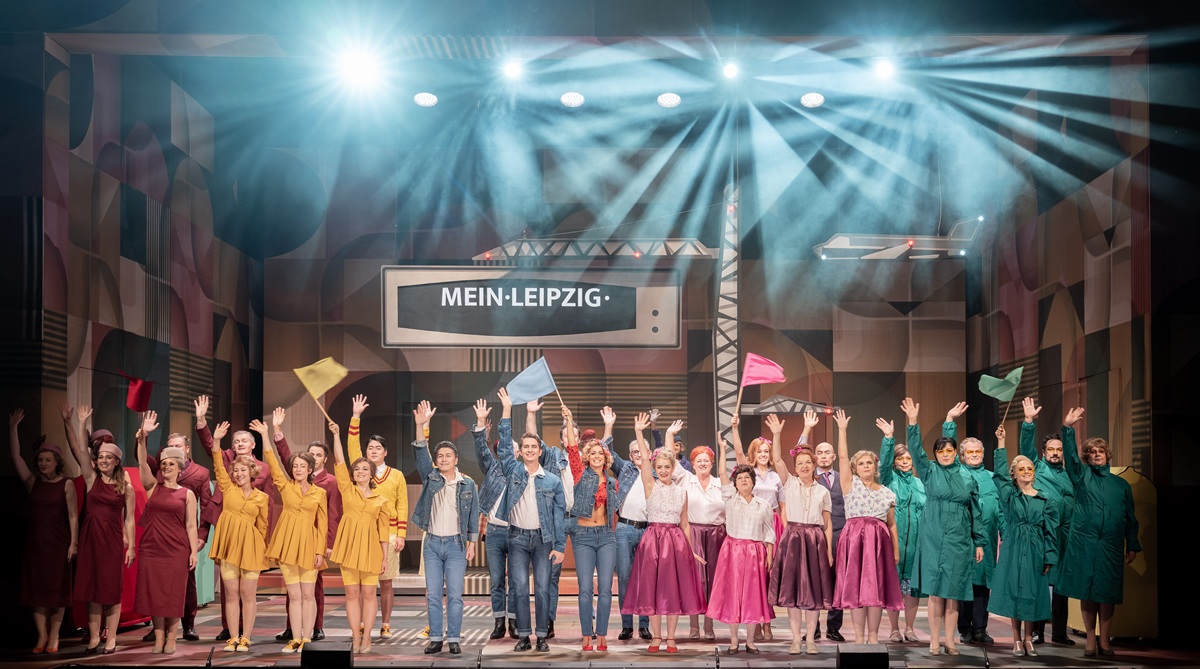
The whole ensemble in the opening scene of “Messeschlager Gisela” production at Staatstheater Cottbus, 2025. (Photo: Bernd Schönberger)
The operetta Messeschlager Gisela by Gerd Natschinski (music) and Jo Schulz (libretto) provides sufficient answers to all of these questions. And the answers are ones that audiences today are eager to hear again, after decades. The show, which premiered in 1960 and is set at the VEB Berliner Chic deals with the trials and tribulations of the fashion industry – which presents its products to a “global audience” at the Leipzig trade fair – had long disappeared from repertoires.
The DDR’s cultural authorities first took it off the stage after the Wall was built in the summer of 1961. The show’s plot is that those who aren’t quite so ideologically “stable” repeatedly “cross over” to the West, to seek inspiration in the Dior department of the luxury department store KaDeWe or to look for rich, capitalist men in cocktail bars who will buy them everything unavailable on the other side of the Iron Curtain. The show was reworked by Natschinski and his co-author and re-staged, but was deemed problematic and not performed too often, by no means as often as Natschinski’s Oscar Wilde adaptation Mein Freund Bunbury (1964).
Peter Lund’s Version at Neuköllner Oper
After the fall of the Berlin Wall in 1989/90, it was completely dropped everywhere because people in the East no longer wanted to remember their own immediate past with a show that formulated its ideological messages so insistently (the “good” workers ultimately triumph over the corrupt representatives of a late-bourgeois, decadent, patriarchal society). It wasn’t until 1999 that Messeschlager Gisela managed to cause a sensation again at the Neuköllner Oper in a new version by Peter Lund – as a charming piece of Ostalgie (nostalgia for West Germans).
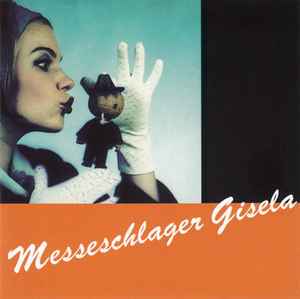
The “Messeschlager Gisla” cast album from Neuköllner Oper Berlin, 1999.
In the same year, the play was also staged at the Cottbus State Theater, where it was presented as Ostalgie (this time for East Germans). It was a huge hit with many allusions to things that many locals could remember all too well – after all, Cottbus once had an important textile industry. Some may have even remembered that Messeschlager Gisela had already been staged in Cottbus in 1961, as the first production after its world-premiere at the Berlin Metropoltheater. (The original version was performed then, which was later consigned to the poison cabinet of history.)

Poster for the revival of “Messeschlager Gisela” in Cottbus, 1999. (Photo: Archiv Roland Dippel)
And now a third new production in Cottbus – this time based on the version of Axel Ranisch, which he successfully staged himself at the Komische Oper Berlin in 2024, together with his congenial musical partner Adam Benzwi, who brilliantly re-orchestrated Natschinski’s snappy music for a smaller band and transformed it into a uniquely new nostalgic pleasure (read more about it here).
Attacks by Right-Wing Extremists
So, in Cottbus, third time round, they’re showing the latest developments regarding Gisela. As I drove to Cottbus, I thought: It’s kind of cool that they are performing a version in a city that so often makes headlines with right-wing extremist attacks and AfD approval ratings, in which Ranisch has turned two of his characters into queers, for whom he creates a special happy ending – the seamstress Ingrid, now transformed into a male “Inge,” and the Leipzig hotel owner Paul Püschel (“Priemchen”) come together. It’s completely unfussy, it’s simply part of the whole picture. It’s fitting that Ranisch was just awarded the new QMS Respect Award this week at the Frankfurt Book Fair, established by the Queer Media Society together with the Hessian Minister of Arts and Culture, Timon Gremmels (SPD), for his ongoing commitment to queer visibility. It’s also fitting that the queer Sorbs in the student city of Cottbus recently unfolded a giant rainbow flag to demonstrate that “tradition” can be combined with a progressive lifestyle. And now this lovingly queer reinterpretation of Messeschlager Gisela?
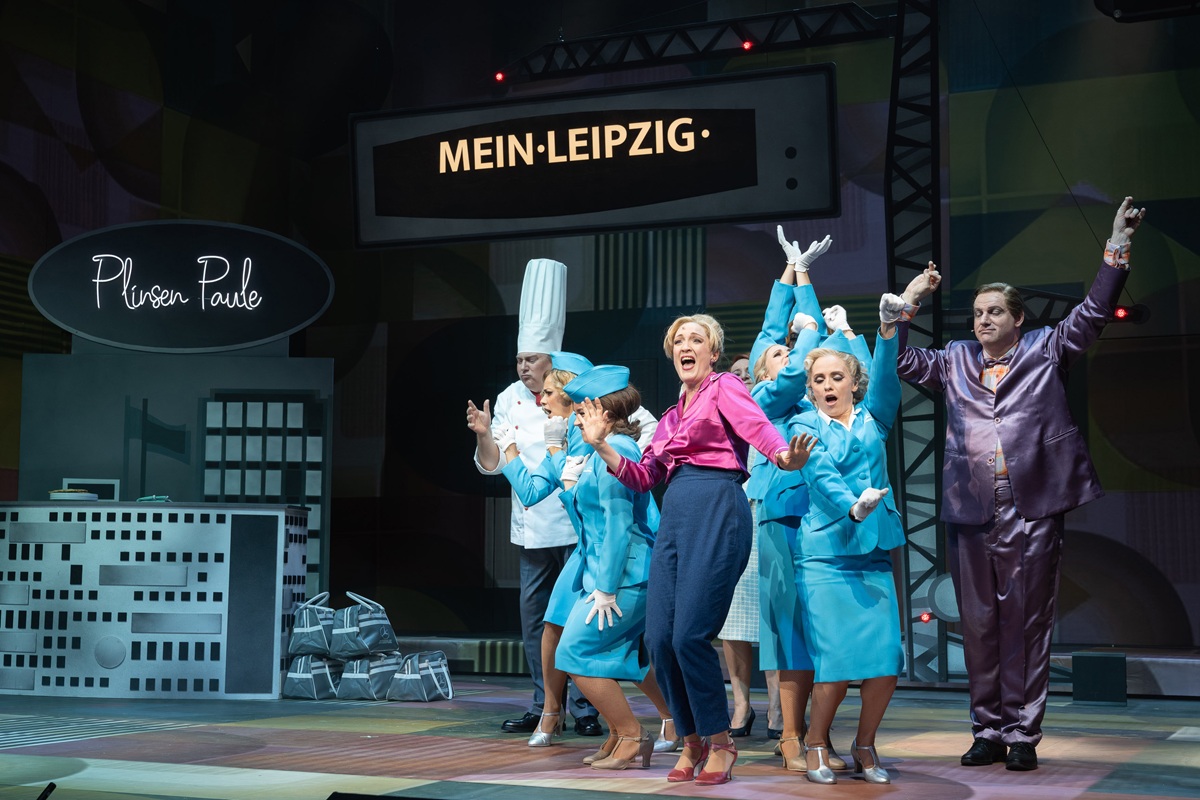
Julia Klotz (in the pink-blue outfit) as Marghueritta Kulicke with the dance ensemble in “Messeschlager Gisela” in Cottbus, 2025. (Photo: Bernd Schönberger)
As the curtain rises to the sounds of Natschinski, superbly coordinated by conductor Johannes Zurl and his huge orchestra, we find ourselves in a kind of XXL box in this production by “musical comedy specialist” Katja Wolff, a box which functions as an unchanging stage space for all three acts. Lined with pastel green-yellow-pink-beige patterns, the box looks a bit like retro wrapping paper. Inside, moving decorations provide the necessary context for the action (stage design: Cary Gayler).
Intensified Color Schemes
Dressed in squeaky costumes, also in a DDR retro look with significantly intensified color schemes, the enthusiastic choir and five dancers enter, setting the pace for what follows. Namely, the story of the hardworking and inventive fashion designer Gisela, who has designed a practical and versatile dress for today’s woman. However, her colleagues at VEB Berliner Chic aren’t allowed to sew it because the company’s director and chief designer, Robert Kuckuck (brilliantly played by Heiko Walter), can’t stand any competition that might outshine his own. Only when journalist Fred Funke shows up (played and sung with radiant tenor voice and verve by Hardy Brachmann) do things start to move. He helps develop a plan with workshop manager Emma Puhlmann (phenomenally likeable: Gesine Forberger) and quality control inspector Heinz Stubnick (Nils Stäfe), and of course, “Inge” the dressmaker, on how to circumvent Kuckuck’s “melon” model and make Gisela’s alternative design a “trade fair hit” in Leipzig.
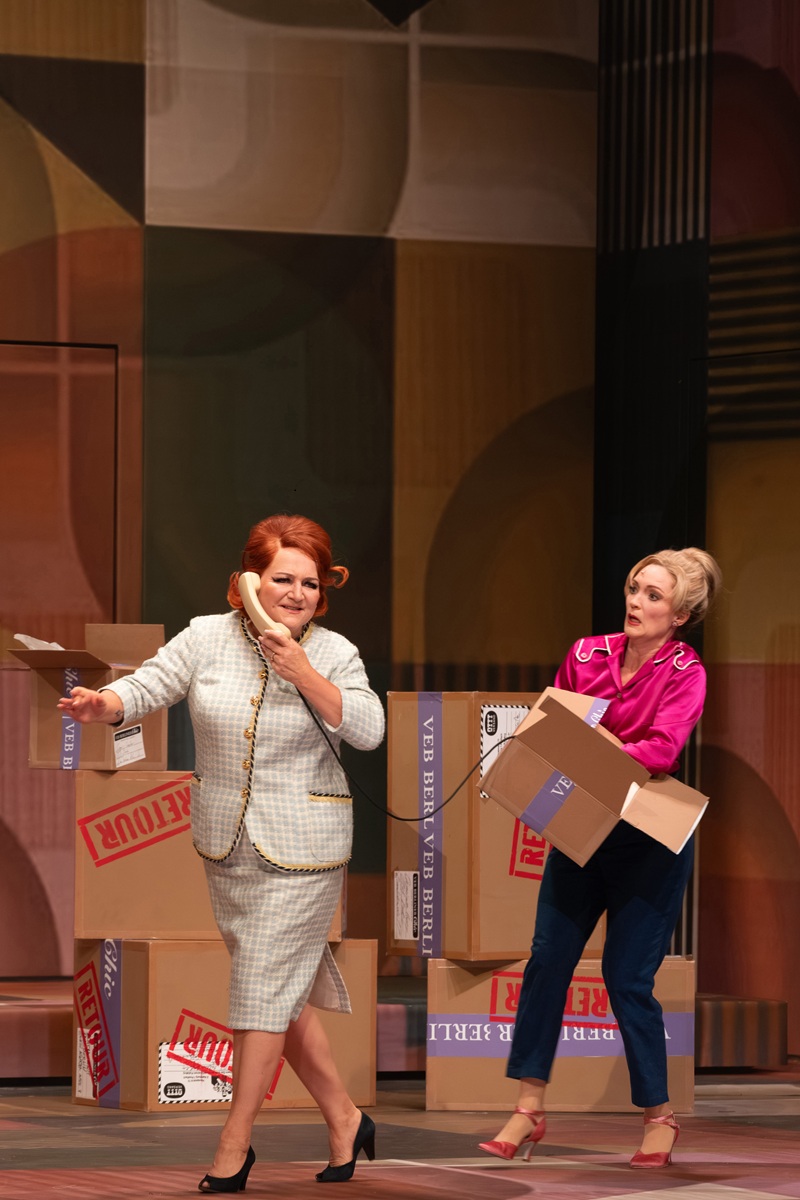
The amazing Gesine Forberger as Emma Puhlmann (left) und Julia Klotz as Marghueritta Kulicke in “Messeschlager Gisela” in Cottbus. (Photo: Bernd Schönberger)
These internal intrigues of the story – radically shortened by Ranisch and trimmed to turbo speed – are peppered with numerous ideological phrases, which the Cottbus audience of 2025 greets with loud laughter. Because they obviously recognize each of these phrases and know what they once stood for. This was different to last year in Berlin in Ranisch’s production, where very few of the (significantly younger) audience remembered such details. In Cottbus, there is hardly any young audience, nor any recognizable student groups; instead, the impression is more of a conservative subscription clientele. But they are in a party mood, because the premiere guests went along with the show almost ecstatically, clapping frenetically, some even singing along at times. And they delighted in this subtly ironic reencounter with their own past.
“Red Roses”
There’s a lot of dancing. Almost every number—even the most intimate duet moments, like the intoxicating “Red Roses”—is expanded into showpieces, as if director Wolff were afraid of creating emptiness. (She’s a musical comedy specialist… and everyone knows that in German musicals, more is always more, and nonstop movement is apparently necessary.) At least choreographer Thomas Heep ensures fluid and convincing proceedings; it’s not his fault that the stage director avoids moments of introspection. Instead, the full choir comes out again and again, creating overwhelming displays of ecstasy, truly ecstatically realized by Zurl at the podium. (Adam Benzwi had the score played more delicately, with a greater sense of chamber music and the special.)
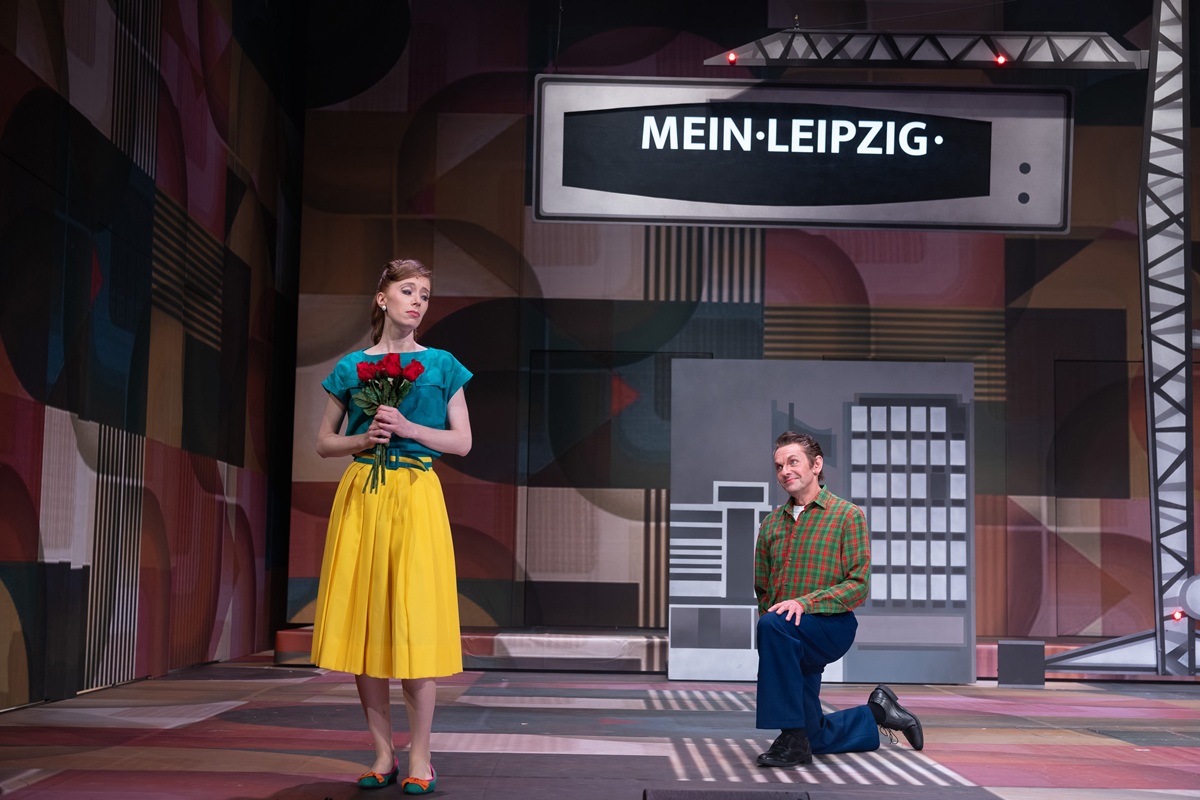
Anne Martha Schuitemaker as Gisela and Hardy Brachmann as Fred Funke in “Messeschlager Gisela” in Cottbus. (Photo: Bernd Schönberger)
At the center of the action is Gisela, performed in Cottbus 2025 by the young opera singer Anne Martha Schuitemaker from the house ensemble. Her acting is rather reserved, which, however, suits the character. She sings her big number, “Wie schön, von ganzem Herzen glücklich zu sein,” in the higher original version and instrumentation, because Ranisch/Benzwi had lowered it for Gisela Flake in Berlin. Schuitemaker’s soprano can shine here, but for me, her standard operatic tone is out of place for this role. Nevertheless, she charmingly plays the underdog. And she has a vulnerability amidst the chaos of the intrigue around her that is captivating.
Tragic Would-Be Vamp
The other female star is Julia Klotz as VEB secretary Marghueritta Kulicke, who claims “Ich mache nur auf Figur” and believes she’s destined for greater things. Klotz, like Maria-Danae Bansen in Berlin, puts on a show of her own. She does so impressively, but forgets to portray this would-be vamp as somewhat tragic, because, of course, Messeschlager Gisela demonstrates that this type of capitalism-oriented woman doesn’t fit the work ethic of socialism – and that all her dreams will be buried after the Wall is built, at the very latest; something Ranisch briefly addresses at the end of his version.
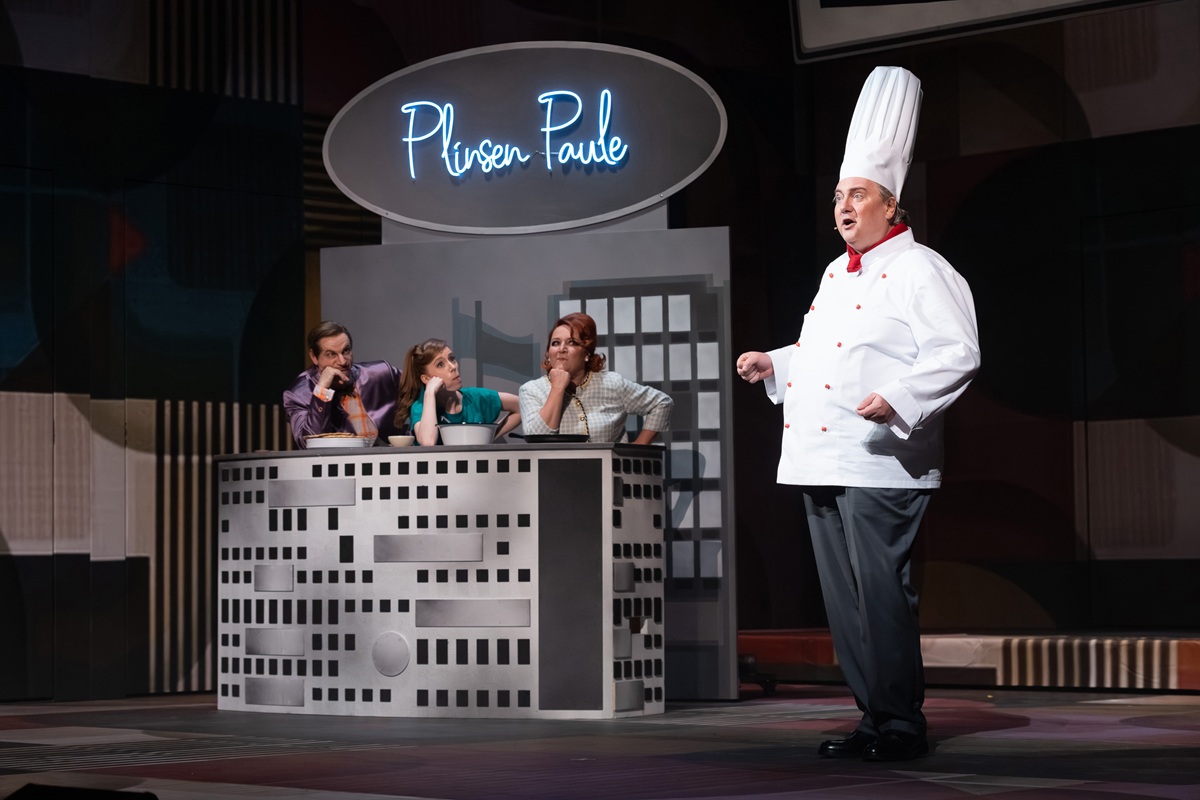
Dirk Kleinke as Priemchen (right); with Thorsten Coers (Inge), Anne Martha Schuitemaker (Gisela Claus) und Gesine Forberger (Emma Puhlmann). (Photo: Bernd Schönberger)
So the question remains: what happens with Inge and Priemchen? Here, I must admit that I’m truly shocked. Because the love story between the two has been omitted. This irritated me so much that after the performance, I spoke with the dramaturge Corinna Jarosch. I asked her why the gay aspect of the plot had been removed—and whether this was out of fear of conservative audiences. As a reminder: In Cottbus, queer youth facilities are repeatedly vandalized and rainbow flags stolen/torn; Pride parades in Brandenburg have to take place under heavy police protection due to right-wing counter-protests.
The Gays Are an Unnecessary Complication
Jarosch explained to me with a beaming smile that neither the actors had refused to play “gay,” nor was the stage director or theater concerned about confronting the audience with such a thing. (The only reference to this in the show now is: “There must be people like that too” someone says, referring to Inge.) Rather, it was decided that this plot line was irrelevant and would have unnecessarily complicated things. So the Ranisch version of Priemchen’s chanson was also rewritten, because in the new version, Priemchen hints in the second act that he had already been interested in other men as a married man—which sets the context for his relationship with Inge. None of this happens in Cottbus 2025. I stared at Jarosch, listened to her explanations, and kept thinking, “I don’t believe this.” It’s like in Johannes Kram’s book Ich hab’ ja nichts gegen Homosexuelle, aber … They don’t have to be visible all the time, right?

The book “Ich hab’ ja nichts gegen Homosexuelle, aber …” by Johannes Kram. (Photo: Querverlag)
Precisely because the Cottbus production decided to perform the Ranisch version, I, as a visitor from Berlin who found this storyline particularly moving at the Komische Oper 2024, was deeply irritated and also annoyed by the decision to simply cut it out without further ado and leave Inge and Priemchen single at the end.
Nevertheless, the production works significantly better on many levels than the one in Berlin in the tent in front of the Red Town Hall. The acoustics in Cottbus are better, the movements click better, and the larger choir has more punch. This staging is definitely to be recommended for operetta fans, thanks to the fantastic soloists, the fantastic costumes, the exciting story, and the way it is received by the local audience. And, of course, the trip to Cottbus is worthwhile for the fantastic music. At the first night party, Natschinski’s widow Gundula (alongside her son Lukas) gave an enthusiastic speech, pointing out that the spirit of her husband, who died in 2015 at the age of 86, was particularly present on an evening like this.
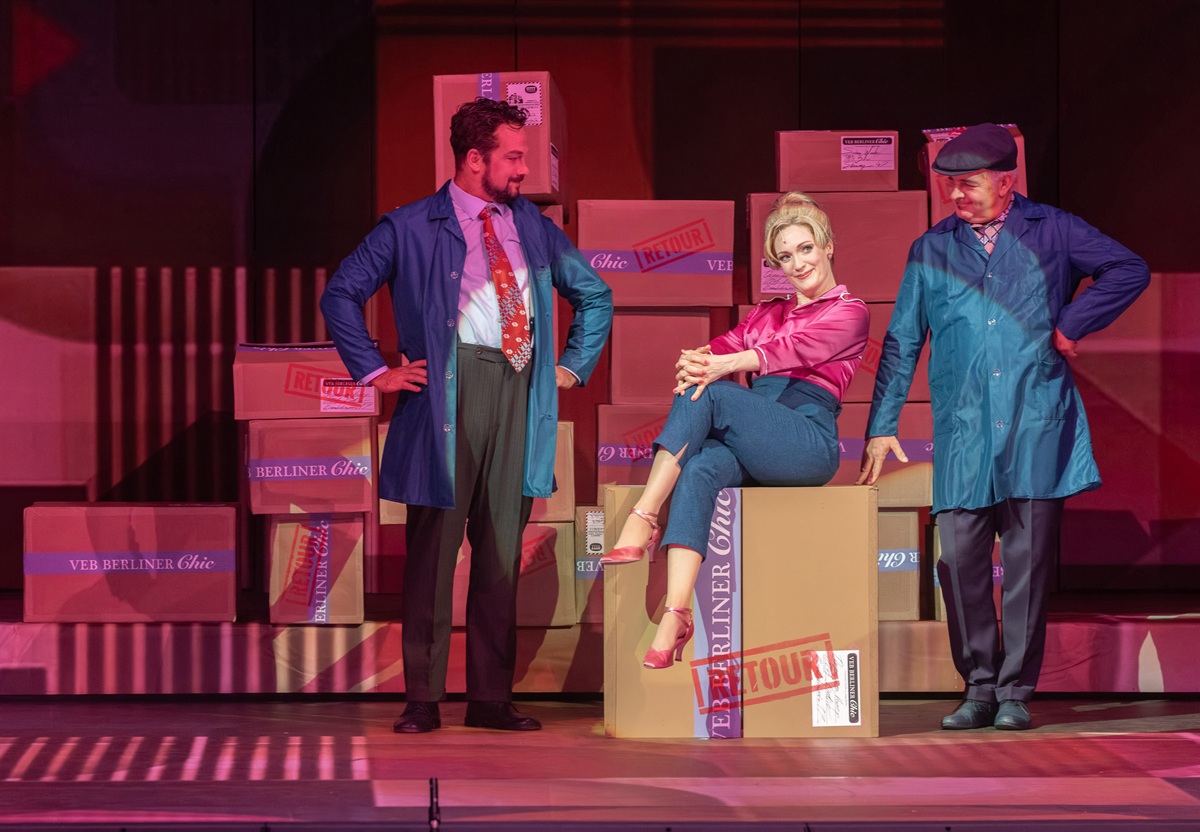
Julia Klotz as Marghueritta Kulicke with members of the chorus. (Photo: Bernd Schönberger)
Messeschlager Gisela, along with Mein Freund Bunbury, is undoubtedly the best thing Natschinski has written for the stage and is definitely worth getting to know – a form of “contemporary operetta” that, to this day, is far too often met with disinterest and ignorance in the West, even though literature on the subject has recently been increasingly published (read more about this here). There are four more performances in Cottbus until December 19th. Dramaturgs from Dresden and elsewhere were present for the premiere, as were a few prominent stage directors. So – who knows what will happen next!
For more information and performance dates, click here.