
Kevin Clarke
Operetta Research Center
12 July, 2026
The 2026 edition of the Lehár Festival turns its attention to medieval Florence, opening on 11 July 2026 with Franz von Suppé’s Boccaccio, an operetta that, according to the festival’s announcement, “brilliantly excels in every respect.”
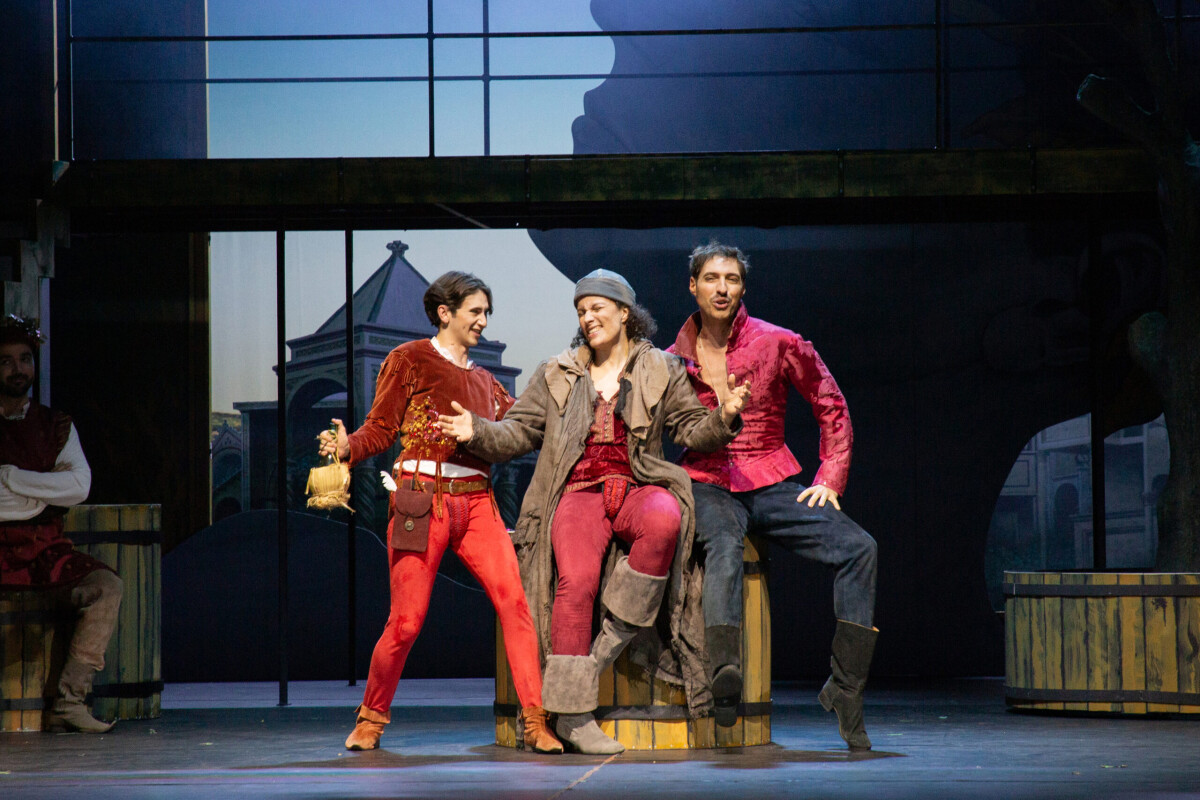
Christina Sidak as Bocaccio (middle) with Philip Guirola Paganini and Martin Lechleitner. (Photo: Foto Hofer)
The festival promises “an inexhaustible wealth of musical highlights, sophistication and exuberance,” combined with the witty and humorous libretto by Friedrich Zell and Richard Genée.
The official synopsis reads: “Medieval Florence is in turmoil, and the notorious poet Boccaccio is to blame. With his tales of the uninhibited love lives of Florentine ladies, he drives the city’s honourable gentlemen to outrage, while the women gladly succumb to the poet’s irresistible charm. Before long, however, the daring hero finds himself caught in a romantic adventure that promises to become more than material for his next novella. As an angry crowd publicly burns his books, Boccaccio has already lost his heart to the most beautiful woman in Florence.”
Regarded as one of Suppé’s greatest triumphs, Boccaccio receives its first-ever staging at the Lehár Festival Bad Ischl.
Festival director Thomas Enzinger stages the production himself, using a new “Spielfassung” by dramaturg Jenny W. Gregor. Christoph Huber conducts.
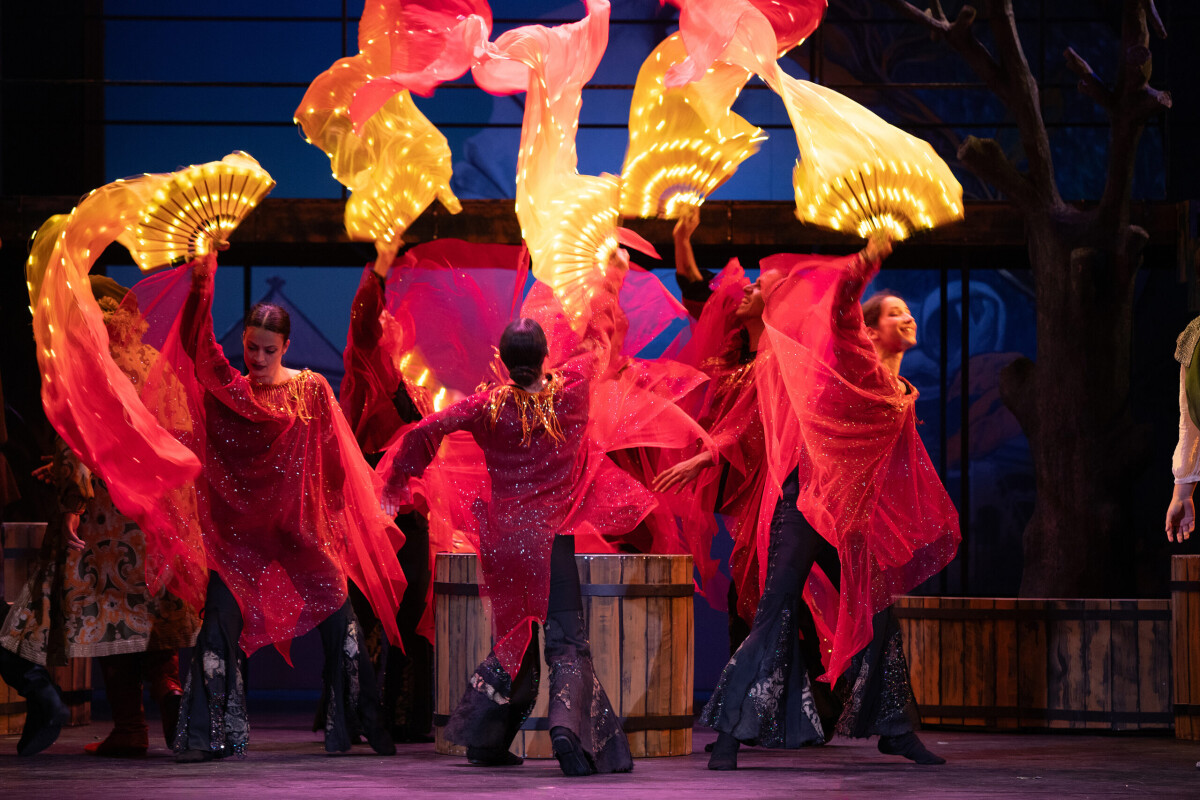
Dance scene fxrom “Boccaccio” at the Léhar Festival 2026. (Photo: Foto Hofer)
Christina Sidak appears in the title role, thus restoring Suppé’s original conception of Boccaccio as a cross-dressed role for a female performer. The choreography is by Lukas Ruziczka, who made his operetta debut at the Lehár Festival in 2024 with Carl Millöcker’s Der Bettelstudent and returned in 2025 for Jacques Offenbach’s Orpheus in der Unterwelt. Boccaccio marks his third consecutive season as choreographer at the festival.
Reviewing the premiere for Bayerischer Rundfunk, Stefan Frey criticises the production’s lack of spoken dialogue and remarks that the sung text is “often difficult to understand.” He goes on saying:
“The highly energetic ensemble does everything imaginable to make the performance work, above all Christina Sidak in the title role—assured and vocally impressive with an expressive mezzo-soprano that blends beautifully with Maria Laduner’s lyrical soprano as Fiametta. Their duets provide the few moments of genuine emotional repose in an otherwise broadly comic burlesque revolving around the married couples Lotteringhi and Lambertuccio. Domencia Radlmaier and Miriam Portmann remain somewhat underused as the ever-willing wives, while their deceived husbands, Gerd Vogel and Hans Gröning, throw themselves enthusiastically into the comic business. Apart from a handful of topical political couplets, however, the production lacks bite, and even the burning of Boccaccio’s books remains surprisingly harmless. Choreographer Lukas Ruziczka transforms the book burning into a colourful revue tableau with flowing, shimmering red veils rather than challenging the audience. Yet it is precisely such contemporary ruptures that one might have expected—and indeed hoped for—from a new adaptation.”
Instead, audiences are treated to lavish visual splendour, with historical costumes by Sven Bindseil and Botticelli-inspired scenic designs by Stefan Weil.
Musically, the evening proves opulent. Suppé’s score overflows with italianità, magnificent choral writing, operatic ensembles and an endless succession of memorable melodies. “The music has aged far better than the plot, which is no longer capable of causing scandal—at most provoking feminist protest,” Frey observes. (He doesn’t say whether there were any actual protesters in front of the theater.)
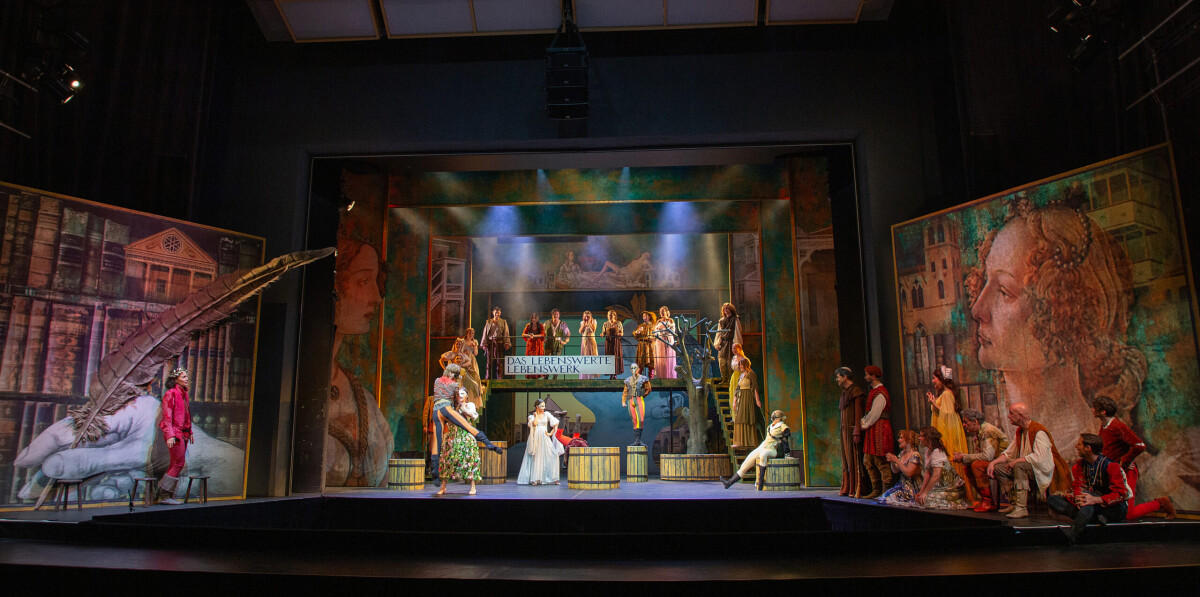
A panorama view of the staging of “Boccaccio” at the Léhar Festival 2026. (Photo: Foto Hofer)
Frey hints, instead, that the production deliberately sidesteps the work’s potential to engage with questions of sexual freedom, the subversion of bourgeois morality and surprisingly modern issues of gender identity—all themes that are embedded in the operetta itself. Yet such restraint is hardly unexpected from Thomas Enzinger and the Lehár Festival, which has established its reputation through intentionally “traditional” productions, far removed from the more explosive approaches associated with directors such as Barrie Kosky or Christian Weise, or companies such as tutti d*amore. The 2026 season does nothing to alter that artistic profile.
Further performance dates are available on the Lehár Festival website.
What for me as operetta lover would be particularly interesting is whether Bad Ischl played the original version with the big pantomime which is never included (I know only one exception of a production in St. Gallen, Switzerland).
I sadly miss the discussion about original versions in this website anyway. Of a lot of very good operettas as Boccaccio, Madame Dubarry, Gasparone, etc. I miss (really) complete (uncut!) recordings in the original orchestration.
And I miss the discussion of this subject on this website.