
Kevin Clarke
Operetta Research Center
29 November, 2025
A long-lost musical treasure is coming back to life. On December 13, 2025, the little theater in Annaberg-Buchholz will premiere the first German performance of Die gelbe Lilie, a two-part “Hungarian Rhapsody” by Michael Krasznay-Krausz.
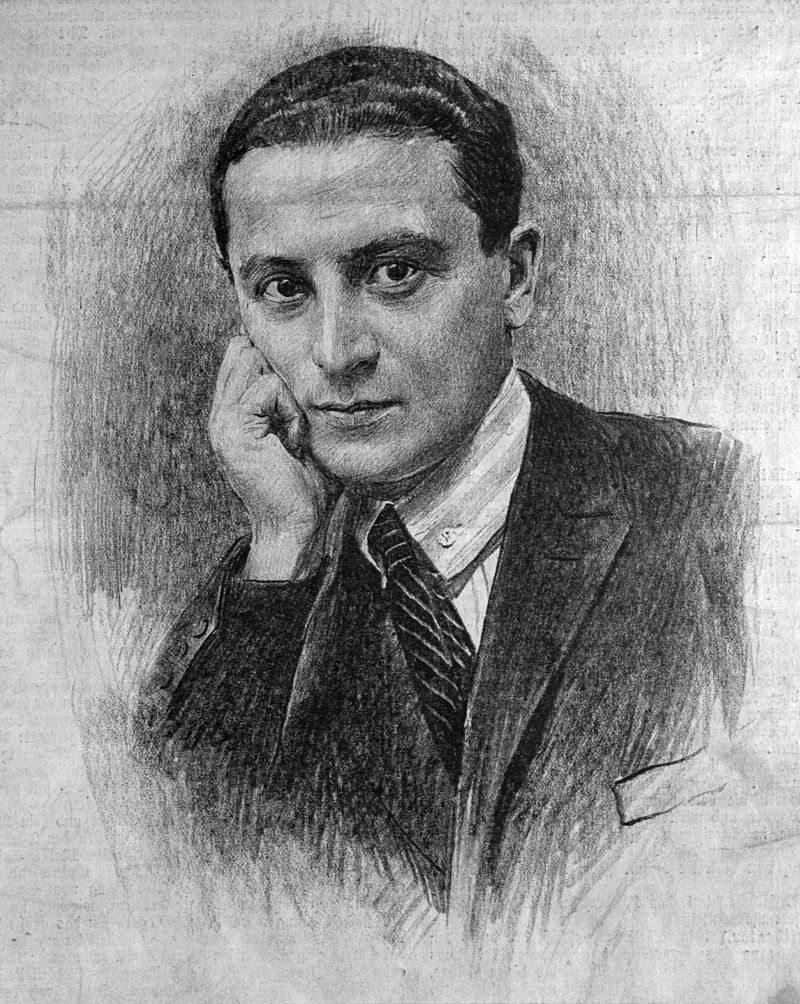
Composer Michael Krasznay-Krausz (1897-1940). (Photo: Der Humorist, vol. 24, iss. 44)
Based on a play by Hungarian writer and screenwriter Lajos Bíró (1880–1948), whose works include the classic film The Thief of Bagdad (1940), the story combines romance, intrigue, and sharp social commentary. With a new German text by Christian von Götz, this revival promises to transport audiences to the sun-soaked Hungarian Puszta, where love, ambition, and political resistance against fascism collide in a vividly theatrical way.
Set against this backdrop, the story centers on “a love- and life-hungry, yet radically emancipated young woman, a hedonistic prince admired by men and women alike for his virtuoso fencing and riding skills, and a Jewish intellectual poised to become a torchbearer of anti-fascist resistance.” This vibrant mix of characters, framed by comedic and colorful figures, forms the heart of a remarkable rediscovery of early 20th-century musical theater.
Krasznay-Krausz, now largely forgotten, was one of the era’s most gifted composers. He achieved major success in Berlin in 1927 with Frau von Format, starring Fritzi Massary. He also composed new numbers for the Berlin premiere of Romberg’s Student Prince at Großes Schauspielhaus.
But with the rise of the Nazis, the Jewish composer was forced to flee Berlin in 1933 for Vienna, and later Budapest.
Die gelbe Lilie premiered on January 5, 1934, at the Budapester Stadttheater. Its German-language premiere followed on May 24, 1934, at Vienna’s Theater an der Wien. Audiences quickly noticed that several of its songs sounded strikingly similar to numbers from Paul Abraham’s Märchen im Grand-Hotel, which had opened just two months earlier. This observation sparked a legal battle, with Abraham accusing Krasznay-Krausz of plagiarism. The composer successfully defended himself, proving that the disputed pieces had been composed as early as August 1932. The case ended amicably. Over the following years, Die gelbe Lilie enjoyed twenty performances in Budapest.
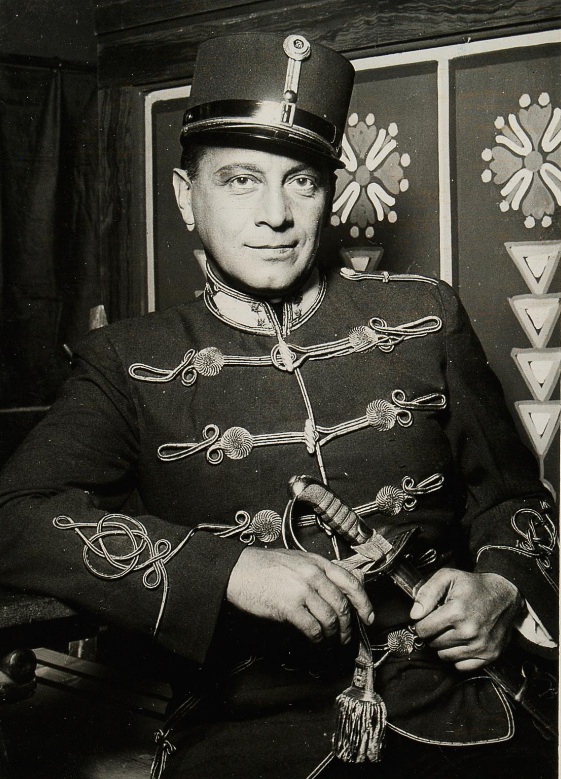
Ivan Petrovich in “Die gelbe Lilie” in Vienna, 1934. (Photo: Atelier Willinger/Theatermuseum Wien)
Krasznay-Krausz continued composing in Vienna, preparing a new work, Mädel in Gefahr, for the Theater an der Wien following the success of his musical crime novel Dixie in February 1938. Scenes were rehearsed and broadcast on the radio, but the “Anschluss”—the annexation of Austria by Nazi Germany—prevented its premiere. The theater was closed on March 17, 1938, forcing Krasznay-Krausz to return to Budapest completely.
His final work, Marion, premiered unsuccessfully on March 23, 1940, at the Budapester Stadttheater. Krasznay-Krausz died later that year, on November 3, 1940, at the age of 43, and was buried in Budapest’s Jewish cemetery on Kozma Street.
Back to the Future
Christian von Götz, a three-time recipient of the Bayrischer Rundfunk’s “Operetta Frog” award and an expert in reviving works by suppressed composers, has taken on the task of bringing Krasznay-Krausz back to the stage. Von Götz recently staged Frau von Format at the Cologne Opera, with Annette Dasch in the title role and Adam Benzwi conducting, demonstrating his skill in reintroducing the composer’s work to contemporary audiences – with a noticeable queer twist.
For Die gelbe Lilie, he envisions a play- and dance-driven anti-war musical spectacle that highlights both the year of its creation, 1934, and the tragic life of its composer.
The production will be conducted by Markus Teichler, with von Götz also responsible for staging, sets, and costumes. The cast features Angus Simmons as Prince Stefan, Zsófia Szabó as Judith Peredy, Richard Glöckner as Max von Hessen, and László Varga in drag as the Baroness Gleichingen.

Preview image for the production of “Die gelbe Lilie” in Annaberg-Buchholz. (Photo: erzgebirgische.theater)
Through this revival, the theater in Annaberg-Buchholz continues its mission of uncovering forgotten gems, offering audiences a rare chance to experience a long-lost chapter of European musical history. Die gelbe Lilie unites past and present, bringing to life a work that embodies both the joy and turbulence of its era while celebrating a composer whose remarkable talent was nearly erased from memory. Sadly, Krasznay-Krausz was not part of Barrie Kosky’s revival project in the 2010s and was only now – post-Kosky – brought back into the spotlight.
For more details click here.
I have thoroughly investigated the plagiarism accusations between Mihály Krausz and Pál Ábrahám in Hungarian newspapers. There was a similarity in one song, four bars of the song were almost exactly the same bar. Budapesti Hirlap, March 27, 1934. .Pál Ábrahám states that he wrote the song in question, “Philippe, mon ami,” in June 1933 and played it in front of a large group in Sankt Wolfgang at the same time. In September, he played the song again on the piano in the office of his stage publisher in Budapest, Dr. Sándor Marton, where Mihály Krausz happened to be present. Pál Ábrahám counter-accused Mihály Krausz in the plagiarism case and reported him to the Vienna Copyright Office.
8 órai újság,17. majus 1934. 9. page:
“Author: In Vienna — Ábrahám, in Pest — Krasznai-Krausz
Yesterday afternoon, the waltz war that broke out between Pál Ábrahám and Mihály Krasznai-Krausz over the four measures that happen to be the same note for note in the waltzes of the operettas A Tale from the Grand Hotel and The Yellow Lily came before the Austrian Authors’ Association (A. K. M.) Court of Rights. The trial was preceded by a barrage of sharp statements, but the trial itself ended peacefully: the court ruled that there was no question of plagiarism, because both composers had written their waltzes independently a long time ago. Krasznai-Krausz stated that he had no intention of accusing Ábrahám of plagiarism, while Ábrahám stated that he did not doubt Krasznai-Krausz’s good faith. Finally, they agreed that in Vienna the number would continue to be included in the Abraham piece and would be left out of the next production of The Yellow Lily, while in Budapest the Grand Hotel would be performed without the waltz in question. The matter was thus concluded to public satisfaction, with no winner or loser.”