
Kevin Clarke
Operetta Research Center
25 January, 2026
When this production of Paul Lincke’s classic Frau Luna opened in Berlin ten years ago, it was one among many operetta sensations in a city where the genre was redefined in the 2010s. Barrie Kosky staged forgotten works by Paul Abraham and Oscar Straus at the Komische Oper; at the Gorki Theatre there was Spoliansky’s Alles Schwindel with the incomparable Jonas Dassler; the Geschwister Pfister turned Dostal’s Clivia into a cross-dressing sensation. And then there was, at the Tipi am Kanzleramt, this silver-glittering Luna with a ensemble of queer stars, proving that both the moon-journey story of 1899 and the quintessentially Berlin music later so badly abused by the Nazis contain enormous subversive potential.
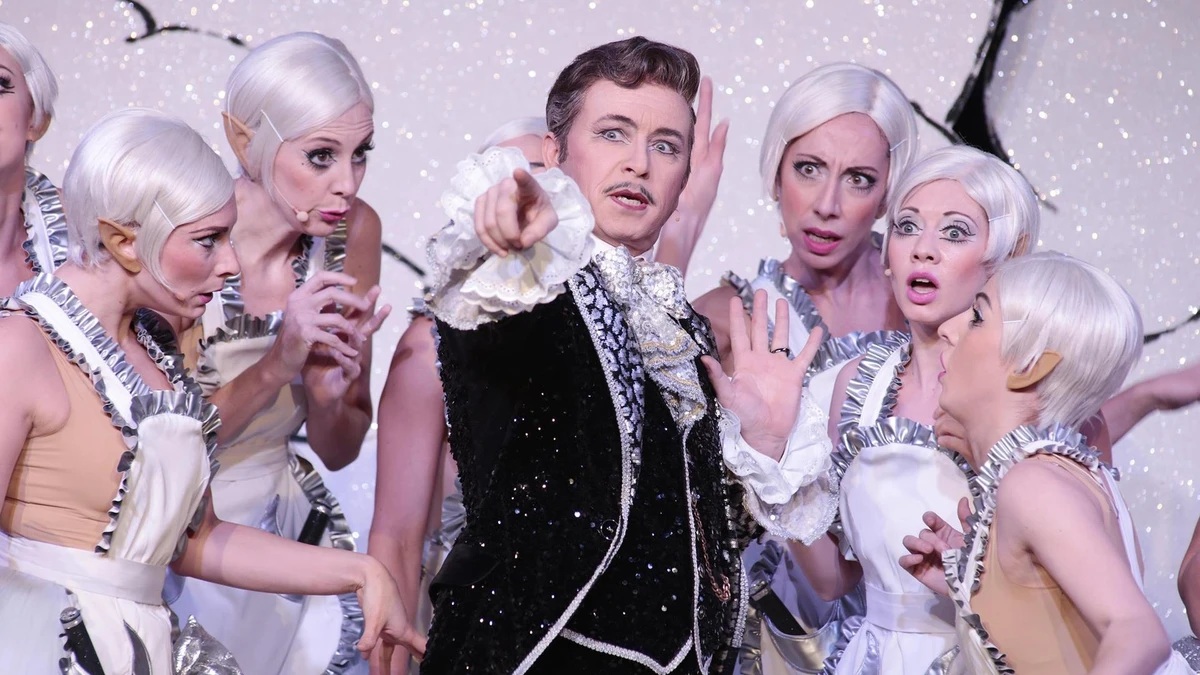
Tobias Bonn as Theophil in “Frau Luna”, 2026. (Photo: Barbara Braun / TIPI AM KANZLERAMT)
In 2016, director Bernd Mottl staged this “burlesque-fantastical operetta of spectacle,” with a libretto by Heinrich Bolten-Bäckers, so that the inhabitants of a working-class district of the capital live in “flat,” mostly black-and-grey 2D sets painted onto cardboard walls. Hans Steppke, the “inventor,” wants to escape this confinement, which is also a moral one. It is personified by Mrs. Pusebach, his strict landlady, who refuses him the hand of her niece Marie because she considers Steppke a financially hopeless case. And she gives him notice, effective the first of the following month.
Steppke and his “bros” Lämmermeier and Pannecke—a tailor and a tax clerk—escape this oppressive situation by traveling to the moon in Steppke’s newly invented aviation balloon. They land among moon elves and discover another world that is freer in every respect. In 1899, at Lincke and Bolten-Bäckers’s Apollo Theatre at the seedy end of Friedrichstraße, the focus was primarily on sexual freedom: the moon elves were lightly clad ladies for whom moral restrictions in dealing with men were unknown. This also applied to Frau Luna herself, who rules there as the goddess of the moon and sets the tone of “Immer Lust und Heiterkeit.”
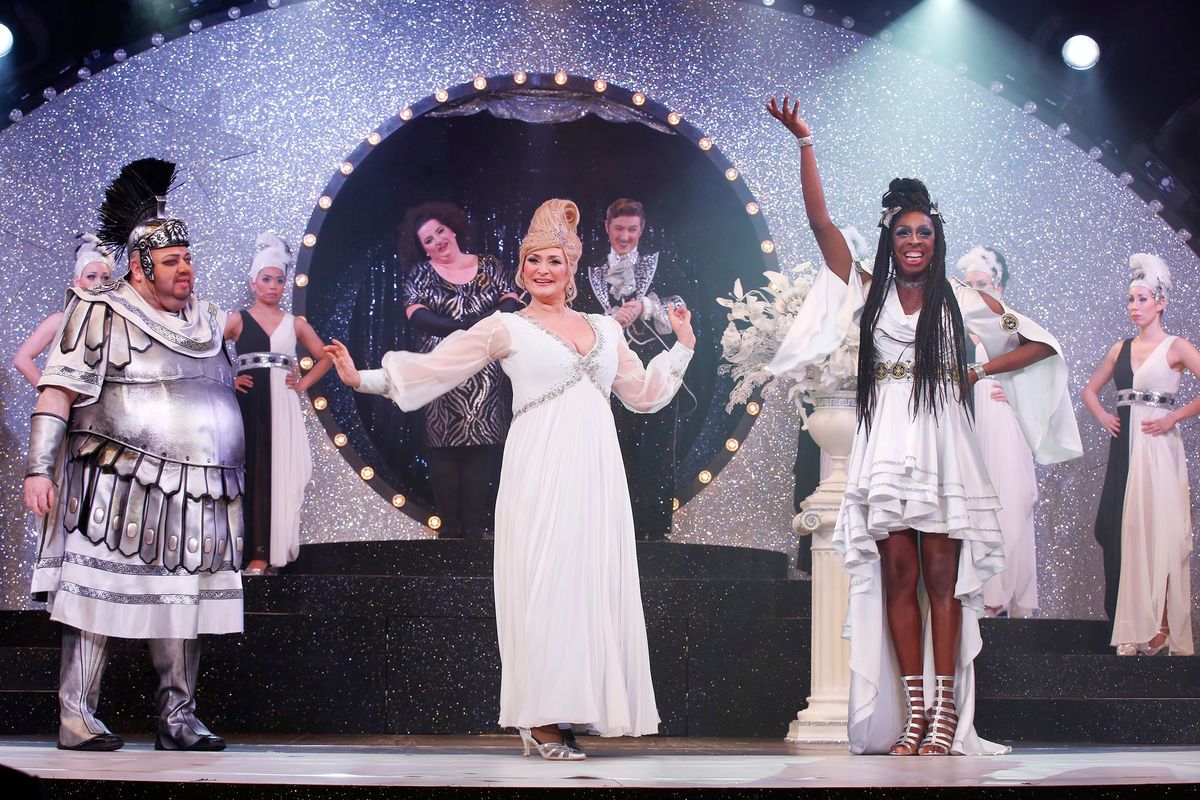
Andreja Schneider (center) as the moon goddess in “Frau Luna” at Tipi am Kanzleramt. Seen here with the 2017 ensemble. (Photo: Barbara Braun / MuTphoto)
Bernd Mottl’s special twist is that he stages this utopia of freedom as if it were a 1970s television studio, where figures like Ingeborg Hallstein, in front of bouquets of flowers, chandeliers, and glittering walls, surrounded by TV ballet dancers wearing fixed smiles, spread a kind of forced good cheer. Everything was “fake.” Yet behind the mask of entertainment one could sense the abyss (in the 1970s, this was the “Deutsche Herbst” with RAF terrorist attacks and, of course, the ongoing reckoning with guilt relating to the Third Reich).
Andreja Schneider from the Geschwister Pfister team appeared as a reincarnated Hallstein—and she was stunning. A caricature that went further, touching the core of truth through its pose. That was great art. Now Schneider returns with almost all the performers who, over three long runs, gave this production its exceptional status: Tobias Bonn as Theophil, the moon’s majordomo; Ades Zabel as Miss Groom, Frau Luna’s maid; Benedikt Eichhorn, Merten Schroeder, and Max Gertsch as the trio Steppke–Lämmermeier–Pannecke; Gustav Peter Wöhler as Prince Stardust, who has long wooed Luna’s love in vain—with his intergalactic star cruiser.
Then there is, of course, Cora Frost as Venus, who sings the “Glowworm Idyll” at the grand lunar celebration in a way as filthy and brilliant as only she can (and I mean that as a compliment). And naturally Christoph Marti as Pusebach, with a touch of Margaret Hamilton (from The Wizard of Oz) and a great deal of longing beneath all the ruffles—which bursts forth in the waltz “Oh Theophil,” and later when she encounters again on the moon her long-mourned acquaintance from the Tiergarten, Theophil. (Yes: Pusebach accidentally travels along, which causes plenty of confusion when her earthly moral views collide with those of the moon—and she reluctantly adapts.)
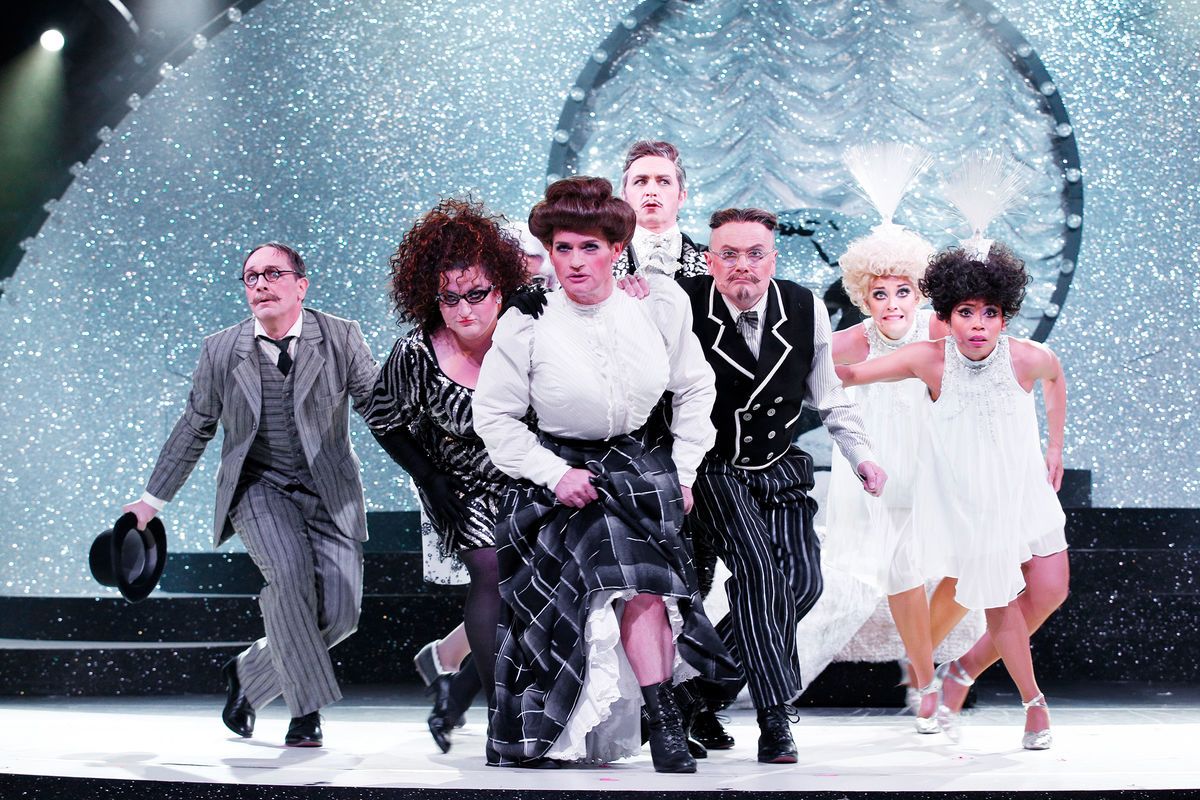
Max Gertsch, Anna Mateur, Christoph Marti, Tobias Bonn, Thomas Pigor, Meri Ahmaniemi, Marides Lazo (left to right) in “Frau Luna.” (Photo: Barbara Braun)
Sharon Brauner is also back as Marie and is allowed to sing the great lyrical moment of the piece—the gently rocking song “Schlösser, die im Monde liegen”—with a completely non-operatic voice, as a heartfelt plea to her Steppke to reconsider his plans to run away. Johannes Roloff conducts a small orchestra with delightful original arrangements of the music, full of witty sound effects and the necessary punch for the hit numbers that regularly send the audience through the roof: the marches “Ist die Welt auch noch so schön, einmal muss sie untergeh’n” and “Das ist die Berliner Luft (Luft, Luft).” Both numbers are brilliantly choreographed by Christopher Tölle.
To experience all of this live again in Berlin in 2026, after an excessively long Corona break—in a city where the operetta scene has changed radically and where little remains of the former “big bang,” since nearly all the productions mentioned above have disappeared—is an almost painful reminder of the transience of things once taken for granted, things one thought would remain forever at that level. (They do not, as a glance at the Komische Oper in the post-Kosky era shows.)

Poster for the 2016 production of “Frau Luna” at the Tipi am Kanzleramt, Berlin.
New to the Frau Luna ensemble this time is Franziska Traub as Stella, replacing Anna Mateur—and that is truly difficult, since Mateur was so overwhelming as the emotionally borderline second maid to Frau Luna, hopelessly in love with Theophil and competing with Pusebach for him, that no one can really match her. Traub does not even try; instead, she plays the role much more quietly. It works—provided Mateur is not tucked away in a corner of one’s memory. Theo Rüster as Mars—traveling as a duo with Venus—rounds out the cast.
I would say this is currently the best operetta production in Berlin’s repertory scene. And it is an absolute joy to see it live again after so long. My companion at the revival premiere did remark that much of it felt like children’s theatre. But this deliberate naivety—combined with the almost manic drill the moon elves display in their TV-ballet moments—is precisely Mottl’s approach to his Hallstein exorcism. It naturally works best if one knows who Hallstein was and what kind of operetta aesthetic she once represented. (There is a famous recording of her with Harald Juhnke as Theophil, Edith Hancke as Pusebach, and Willi Brokmeier as Prince Stardust.)
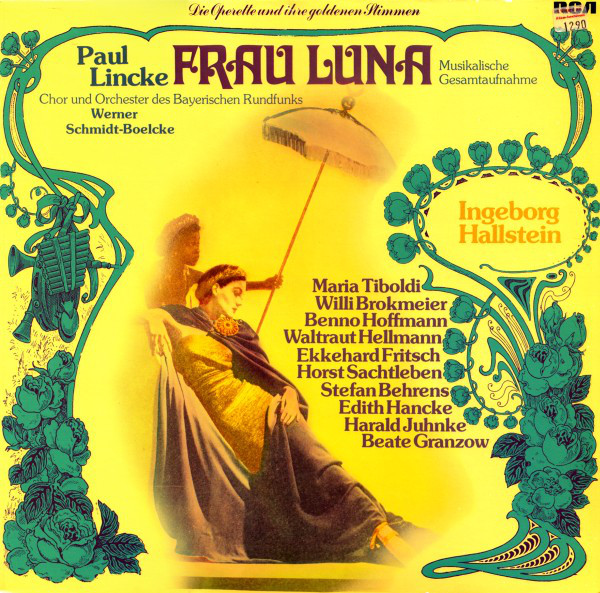
The 1975 hightlights disc of “Frau Luna” atarring Ingeborg Hallsein, on RCA Records.
What is entirely new about this revival, however, is not that it will once again run for three months en suite, but that a remarkable recasting is scheduled for early March: Ades Zabel will then slip into the role of Pusebach with his trademark snarky humor, and Christoph Marti will become the new moon goddess. This promises to be extremely exciting, simply because completely different performer types will bring new interpretive nuances to the roles.
The Tipi has already announced that, for its tenth anniversary, this will be the final revival of this Berlin classic—because it is too elaborate to rebuild the set (by Friedrich Eggert) and to assemble such a large celebrity ensemble (in costumes by Heike Seidler). That means one should go again and again now, as often as possible, before this operetta masterstroke disappears as well. One should definitely see it with both the A and the B cast. And in the best of all possible worlds, the filmed version streamed during the Corona period would be released on DVD.
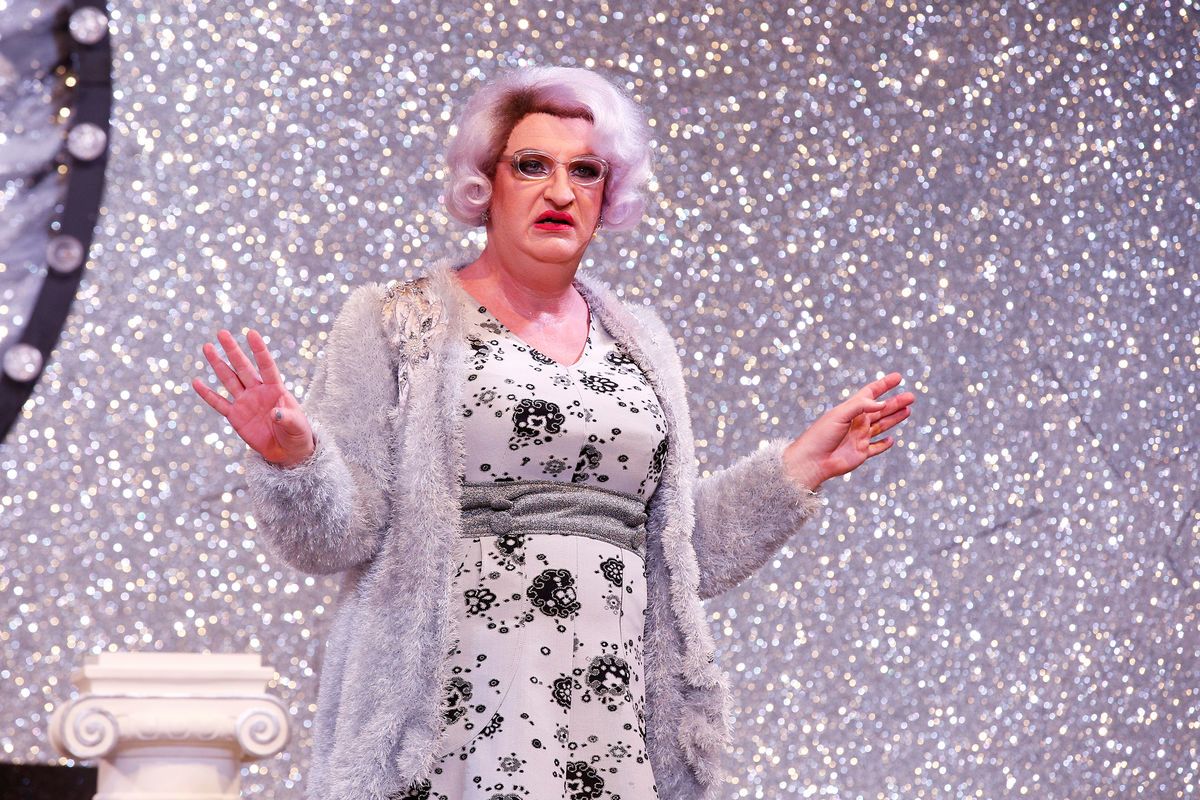
Ades Zabel in “Frau Luna” as Miss Groom. (Photo: Barbara Braun)
A CD of the piece—with Roloff’s wonderful orchestral arrangements—would also be highly desirable, so that it does not all vanish completely and leave nothing but memories.
For more information, click here.