
Kevin Clarke
Operetta Research Center
6 July, 2026
On the first page of the programme booklet, the mayor of the residential town of Neustrelitz describes the Operetta Festival in the palace gardens as “the cultural highlight of this summer” for the town.
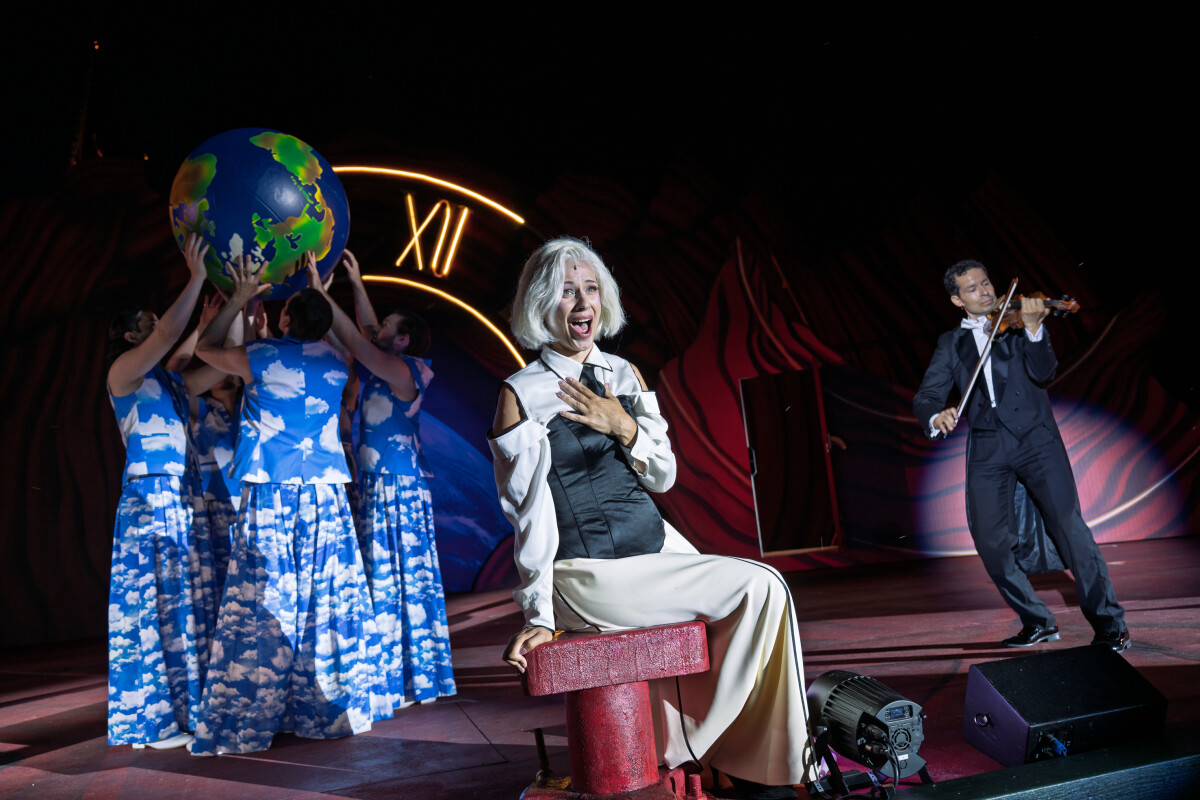
The “Joi, mamam, Bruderherz, ich kauf mir die Welt” scene from “Die Csardasfürstin”, Neustrelitz 2026, with Julia Baier-Tarasova as an alternative cast Sylva. (Photo: Jörg Metzner)
At the same time, he presents it as a demonstration of the artistic capabilities of the Landestheater Neustrelitz and the Neubrandenburg Philharmonic Orchestra. This year’s production of Emmerich Kálmán’s hit Die Csárdásfürstin therefore serves not only as an attraction for operetta enthusiasts travelling from afar, but also as a form of public relations: ideally, it should inspire audiences to return for further operetta performances at the theatre itself. Recent productions there have included Paul Lincke’s Frau Luna as well as rarities such as the Broadway operetta Kismet. None, however, has ever come close to matching the appeal of these large-scale outdoor spectacles.
The theatre’s new artistic director, Sven Müller, argues in the programme that a “careful” reading of operetta enables us today to gain “an authentic insight into the thoughts and emotions of the people of their time.” He is referring to the period of the premiere—in this case the wartime year 1915—which he describes as a “major historical turning point.” In Die Csárdásfürstin, the decline of the old aristocratic order obsessed with class distinctions coincides with the emergence of a more democratic society, embodied by the variety singer Sylva Varescu. Through her own talent she has established both a reputation and financial independence by embarking on a successful American tour. Yet Edwin, the son of Prince Lippert-Weylersheim, is forbidden to marry her because his parents consider her socially unsuitable. Edwin is called up for military service, expected to marry Countess Anastasia (“Stasi”) instead, and to leave behind the sexually liberated world of Budapest’s cabarets. Eventually, however, everything turns out differently after a series of slapstick misunderstandings that all conceal a painful and profoundly realistic emotional core.
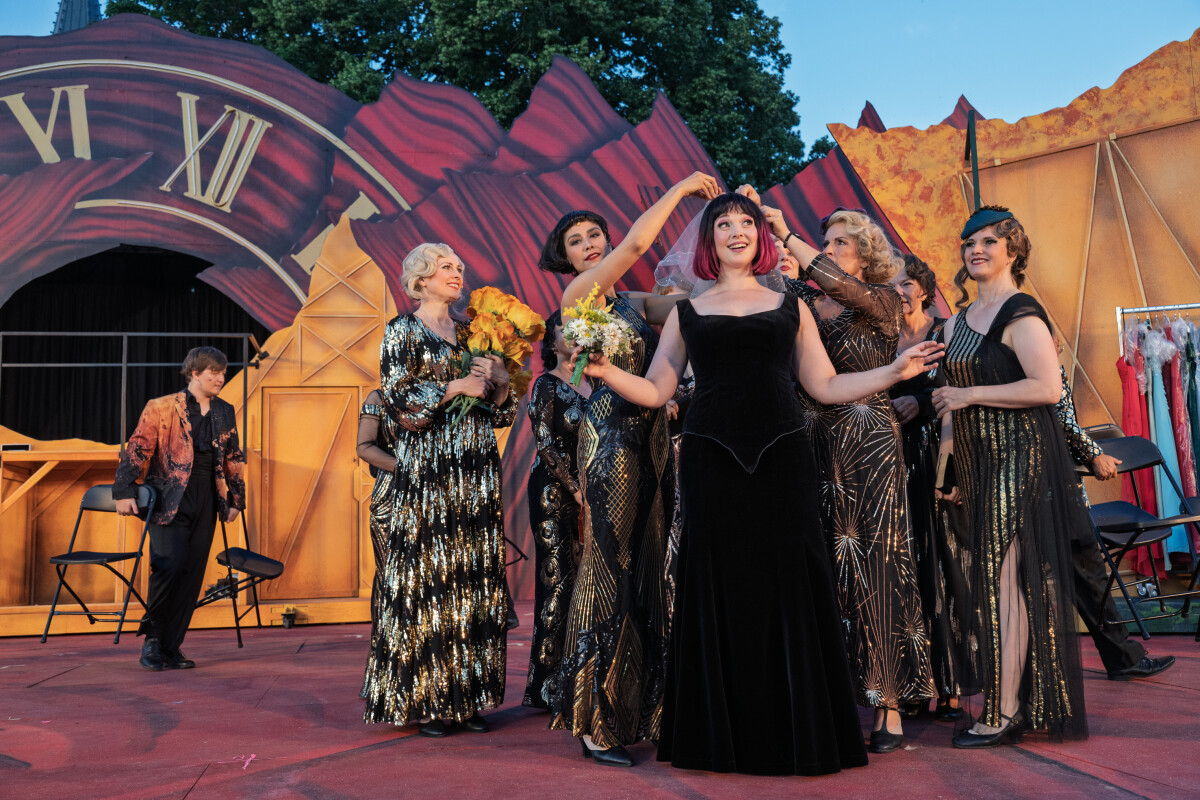
Laura Albert as Sylva in “Die Csardasfürstin”, Neustrelitz 2026. (Photo: Jörg Metzner)
Ironically, Müller’s own production displays remarkably little of the “care” he advocates when it comes to offering anything resembling an authentic perspective on the society of 1915. The work’s clear historical setting is discarded in favour of a visual aesthetic seemingly stranded somewhere in the 1980s: a kitschy operetta fantasy filled with bizarre gold glitter costumes, tiny red swimming trunks for the male dancers, and a set consisting of enormous movable wooden walls painted with red velvet curtains. Especially during the first half, when daylight still illuminates the stage, Lena Brexendorff’s combined set and costume design resembles discarded furniture rather than theatrical imagination: atmosphere-free, cheap, and frankly embarrassing.
According to the programme, Brexendorff seeks to create stage and costume designs “that do not tell stories, but evoke emotions” and “leave room for personal associations.” Her visual worlds are intended to reflect the characters’ “inner states.” Perhaps a chanson star with purple hair wearing an unglamorous dress in front of walls that roll back and forth in the summer wind does indeed represent an “inner state.” It has, however, very little to do with the story created by librettists Leo Stein and Béla Jenbach.
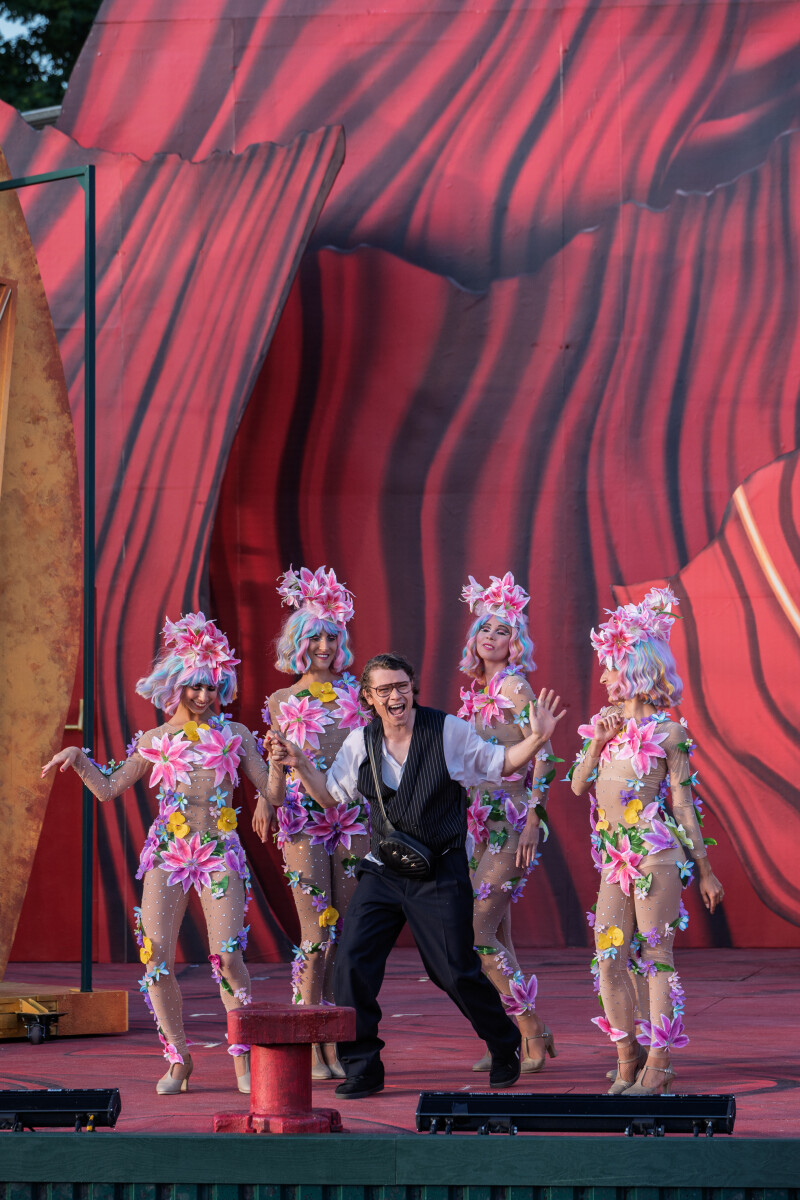
Richard Glöckner als Boni in “Die Csardasfürstin”, Neustrelitz 2026. (Photo: Jörg Metzner)
The supposed “careful” reading raises other questions as well. Why does the buffo character, Count Boni Káncsiánu (Richard Glöckner), repeatedly ask, “Are you my bro?” Why does he speak in hashtags (“#SummerWedding”)? Why do he, Edwin and other characters constantly wave smartphones around and exchange text messages? If this is intended to suggest that the story takes place in the present day, then almost nothing else about the production supports that idea. Rather than offering a genuine reinterpretation, the staging otherwise remains largely faithful to the original dialogue. To me, this suggested that Müller and his dramaturge Martin von Bargen never seriously engaged with operetta as a genre. Instead, they seem content to present “something” and rely on Kálmán’s irresistibly effective score to carry the evening.
In the end, the music does exactly that. Although conductor Kenichiro Kojima does not offer the most individual interpretation of Kálmán’s waltz- and csárdás-rich score, the sheer intoxicating power of the music sweeps the audience along so convincingly that many of the production’s embarrassments are, at least temporarily, forgotten. The audience enthusiastically joins in clapping during “Ganz ohne Weiber geht die Chose nicht,” and the woman sitting behind me even sang along during the entire duet “Machen wir’s den Schwalben nach” in nostalgic longing, while leaning affectionately against her companion.
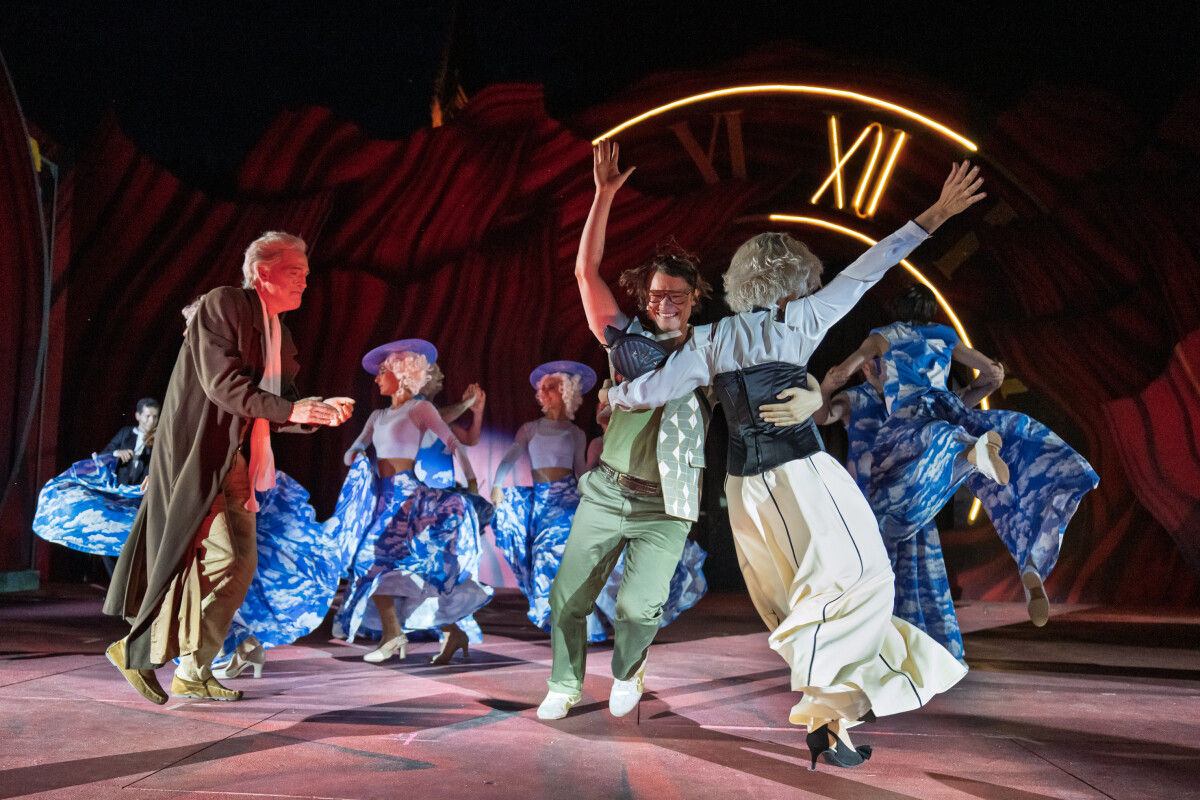
Richard Glöckner and Laura Albert with chorus and ballet in the finale of “Die Csardasfürstin”, Neustrelitz 2026. (Photo: Jörg Metzner)
Laura Albert portrays Sylva as a predominantly lyrical heroine, singing with an attractively shimmering, slightly nervous soprano. Temperamentally, however, she is not really Sylva. She lacks attack, and above all the emancipatory fire demanded by the Act One finale, “Ja so ein Teufelsweib.” One only has to listen to Fritzi Massary, who sang the Berlin premiere in 1916. The label Truesound Transfers has released an excellent restoration of that historic highlights recording (click here for more information). Andrés Felipe Orozco, as Edwin, produces several meltingly beautiful moments but audibly reaches the limits of vocal comfort in the more dramatic passages, and acting wise he never quite inhabits the role.
Completely convincing, by contrast, is Laura Scherwitzl as Stasi. She combines a clear, focused tone with an excellent sense of style and genuine comic flair. One cannot help wondering why she was not cast as Sylva in the first place. Unfortunately, Stasi only appears after the interval in Act Two, by which point the production has already squandered much of its credibility. Richard Glöckner also makes a strong impression as Boni. His performance has the agility of a musical theatre man, although he is constantly required to deliver topical jokes that generate easy laughs while contributing very little to the character. Nevertheless, Boni and Stasi’s scenes rank among the evening’s highlights, as do the appearances of actor David Fischer as Prince Leopold Maria von und zu Lippert-Weylersheim. Why the Prince eventually interacts with an old-fashioned coin-operated telephone during the famous telephone scene—as prescribed by the libretto—while everyone else has been using smartphones throughout remains a mystery.
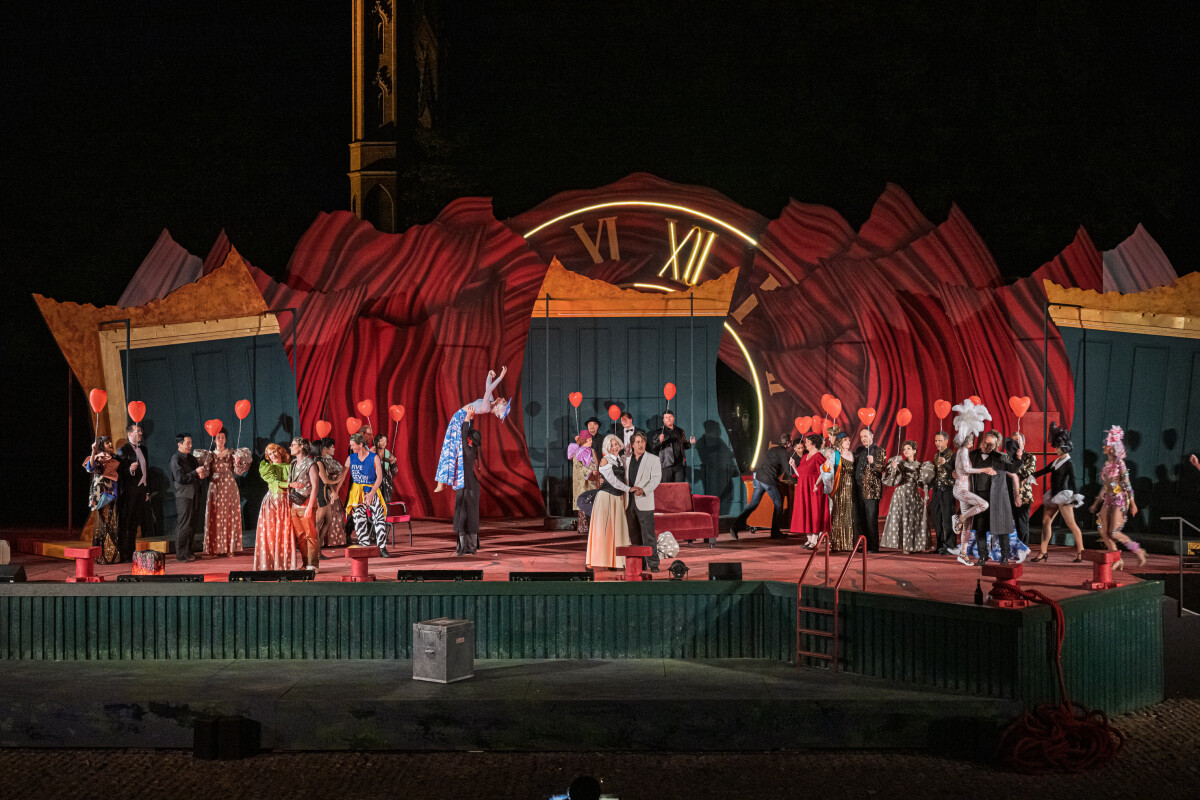
Finale of “Die Csardasfürstin” in Neustrelitz, 2026. (Photo: Jörg Metzner)
The evening concluded with fireworks while the entire cast skipped around the stage to “Tausend kleine Englein singen” in Amy Share-Kissiov’s choreography. My impression was that someone had simply reheated the most tired operetta clichés, as though presenting a nostalgic retro event and as though Barrie Kosky and numerous other directors had not demonstrated over the past two decades just how much richer and more complex these works can be. That message appears not yet to have reached Neustrelitz. Even so, Die Csárdásfürstin still works—considerably better, at any rate, than last year’s Die Zirkusprinzessin.
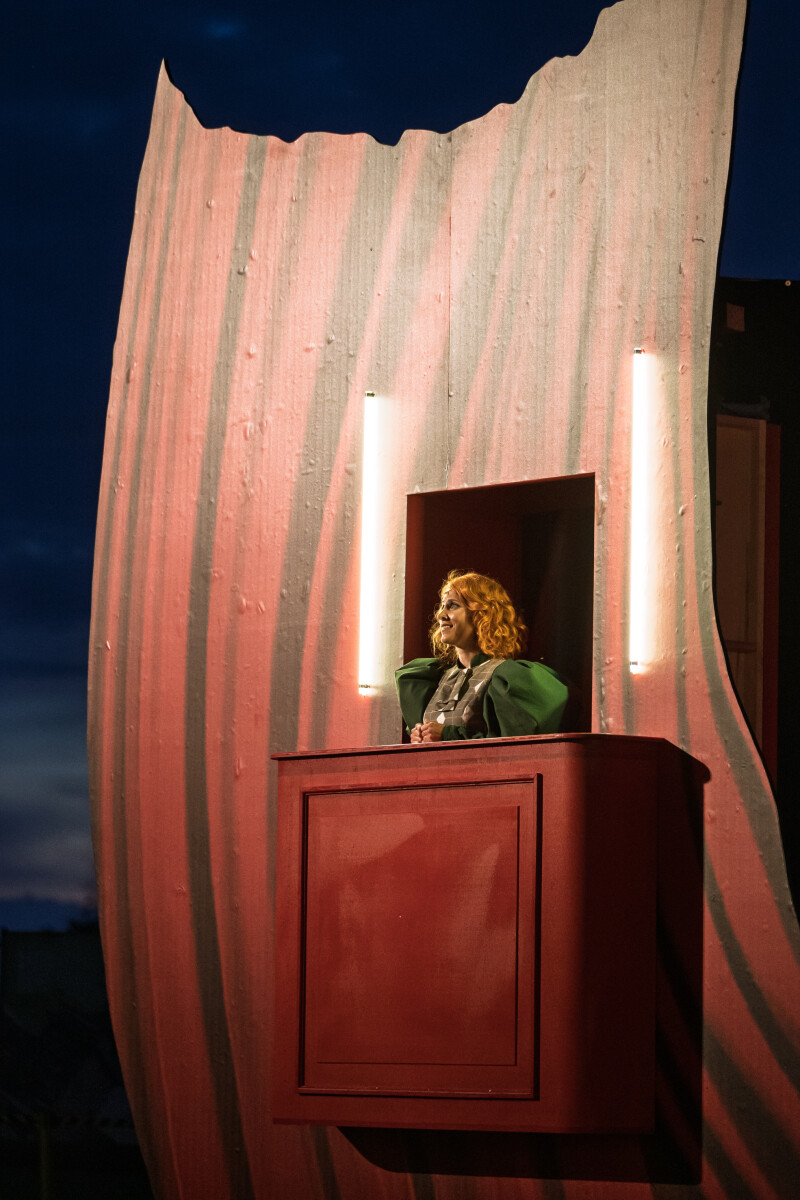
Laura Scherwitzl as Stasi in “Die Csardasfürstin”, Neustrelitz 2026. (Photo: Jörg Metzner)
The audience in Neustrelitz certainly seemed satisfied. Before the performance and during the interval, the palace square enjoyed an exceptionally convivial atmosphere in the evening sunshine, with bratwurst, wine, and live salon music. A new stall selling East German LPs offered rare and fascinating operetta recordings from the Amiga label, including a Csárdásfürstin recorded by the Dresden State Opera and the Dresden Philharmonic under Heinz Rögner. It is well worth hearing. The LP sleeve proudly proclaims: “There is hardly another work in this genre that has achieved such popularity through music that remains alive today, and not only in our country.” More than thirty years after German reunification, that statement still rings true. Only one thing has changed: Kálmán’s music is now in the public domain.
Next summer’s festival will present Eduard Künneke’s Herz über Bord (1935). It will be interesting to see how the theatre approaches a work written during the Nazi era whose score does not ignite audiences as automatically as Kálmán’s. One can only hope that the result will not prove a shipwreck—and that Sven Müller will invite artists who genuinely understand the extraordinary possibilities operetta offers today. Only then might audiences travelling from Berlin and beyond leave this showcase for the Neustrelitz theatre genuinely inspired. The journey to this beautiful residential town is certainly worthwhile, not least because of the remarkable hospitality of the local hoteliers and the warm conversations with fellow festival-goers.
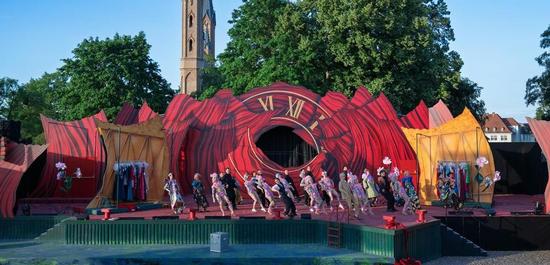
Scene from the “Csardasfürstin” production in Neustrelitz, 2026. (Photo: Jörg Metzner)
Performances of Die Csárdásfürstin continue until 26 July 2026. For more information click here.