
Kevin Clarke
Operetta Research Center
2 January, 2026
Berlin was—and in many ways still is—a center of operetta innovation. A reminder: in the 1920s, crucial impulses for renewing the genre emanated from here, with people such as Erik Charell moving the genre towards jazz and revue. But it was also in Berlin, through Franz Lehár and his partnership with Richard Tauber, that the “tragic operetta” was born—a form in which audiences wept into their handkerchiefs while simultaneously wetting their knickers because of the sensual timbre of the tenor.

Tenor Thomas Blondelle, soprano Vida Miknevičiūtė, and conductor Christian Thielemann (left to right) with Staatskapelle Berlin. (Photo: Stephan Rabold)
More recently, it was directors and conductors such as Barrie Kosky, Christian Weise, and Adam Benzwi who, together with new performer types like Dagmar Manzel and Jonas Dassler, liberated the genre from the twilight zone of an almost zombie-like existence. They demonstrated that operetta can be up to date, contemporary, and accessible to a younger generation—a generation no longer obedient to the Nazi-propagated maxim that these works must be “ennobled” in order to underscore their cultural value.
Instead, subversive wit, Jewish humor, and sheer entertainment value were foregrounded, not to mention a joyful embrace of pop-art kitsch—as seen in productions such as Ball im Savoy or Clivia at the Komische Oper, Alles Schwindel at the Gorki Theater, or Frau Luna at the Tipi am Kanzleramt, to name just a few.
Lehár was largely excluded from all this: first, because Kosky boycotted Hitler’s officially proclaimed “favorite composer” for the longest time, due to Lehár’s proximity to the Nazi regime; and second, because after decades in which the musical establishment had insisted that Lehár’s works were artistically superior to so-called “cheap” hit-song operetta—owing to their supposedly elevated orchestration, compositional technique, and use of counterpoint—that narrative finally seemed to have been overcome. It was shown that Abraham, Oscar Straus, Spoliansky, and others possess their own artistic value and substance—just of a different kind.

Franz Lehár with his star tenor Richard Tauber who premiered all of Lehár’s last operettas.
All of this appears to have passed Christian Thielemann by entirely. Decades after the last truly big new Lehár production in Berlin—one thinks of Peter Konwitschny’s Das Land des Lächelns or Andreas Homoki’s Die lustige Witwe—the new General Music Director of the Staatsoper Unter den Linden now presents himself as a promoter of this repertoire in its most old-fashioned guise. And he does so with ruthless exclusivity, programming it as the New Year’s Eve and New Year’s concerts with the Staatskapelle: highlights from four central Lehár works, three of them explicitly conceived for Tauber, plus The Merry Widow in the 1940 concert-overture version.
When the first bars of this late Lehárian backward glance to his 1905 success sounded, I was briefly … stunned. Because this did not sound at all like the Widow I love—and that became a global hit. Instead, it felt as though Thielemann were conducting Die Meistersinger: the sound was huge, bombastic, lush to excess. The waltzes (“O kommet doch, o kommt, ihr Ballsirenen”) and the endlessly restarting melodies lacked any trace of the cinematic drive one could hear, for example, in Hollywood in 1934, in Ernst Lubitsch’s film version with its massive orchestral forces.
Here, Lehár stood frozen in a state of “ennobled” triviality that, frankly, shocked me. This was operetta without sex appeal, without fun, without a cheeky grin. In short: misguided operetta in Wagnerian format.
It became even more extreme when the soloists appeared. Vida Miknevičiūtė—currently Sieglinde and Elsa at the Staatsoper Unter den Linden—sang Giuditta from Lehár’s late work of the same name as if she wanted to make the world bloom with Wälsungenblut. Meanwhile, Thomas Blondelle, with his more lyrical tenor, sang “Freunde, das Leben ist lebenswert” far beyond his dramatic means, causing his tone to spread unpleasantly and acquire a clattering edge—something that did not improve as the evening went on. (Michael Spyres, Bayreuth’s Siegmund in 2025, had originally been announced as a soloist. What happened to him on the way to Lehár? No idea.)

Vida Miknevičiūtė singing Giuditta’s famous songs. (Photo: Stephan Rabold)
One could say that Thielemann conjured up a historically informed performance practice of the 1970s, when Karajan attempted to reinterpret Lehár as a symphonic poem. Thielemann went one step further, turning Hanna Glawari and her sisters into Götterdämmerung heroines. Or to put it differently: Miknevičiūtė sounded like Adriana Caselotti (from Disney’s Snow White, 1937) whose vocal cords had been injected with testosterone. Power vibrato, yes—but not born of sensual excitement; rather, a blunt-force soprano permanently geared toward maximum volume discharge.
Of course, this is one possible interpretive approach to operetta, even if it seems wildly out of date—which clearly does not bother Thielemann. (Nor, apparently, the largely white-haired audience with walkers and canes.) Still, for two hours I kept asking myself: what is this supposed to achieve? In his New Year’s address, Thielemann emphasized that he wanted to bring this repertoire—one unfamiliar to the Staatskapelle and “so difficult to play” (because of the many tempo changes)—back into public consciousness.
In principle, I think it would be wonderful if Giuditta, the Goethe opus Friederike, or Paganini were once again discussed more widely—and if new performance forms beyond Kosky were found. But as presented here, I experienced this music as hollowly embarrassing. And completely out of place. Does one do Lehár any favors by inflating him to Walküre dimensions and volume levels? I would say: no.

The Staatskapelle with soloists and Christian Thielemann in Staatsoper Unter den Linden. (Photo: Stephan Rabold)
While Kosky has by now withdrawn from the operetta world, and little remains in the Berlin repertoire of his major achievements (the same goes for Alles Schwindel, Clivia, Roxy und ihr Wunderteam, etc.), at least the extraordinary Frau Luna will return to the Tipi in January 2026—an operetta exorcism with a queer star cast, directed by Bernd Mottl, and appearing for the first time since the pandemic. Perhaps Thielemann—or someone responsible at the Staatsoper—might take a look when planning the New Year’s concerts for 2026/27?
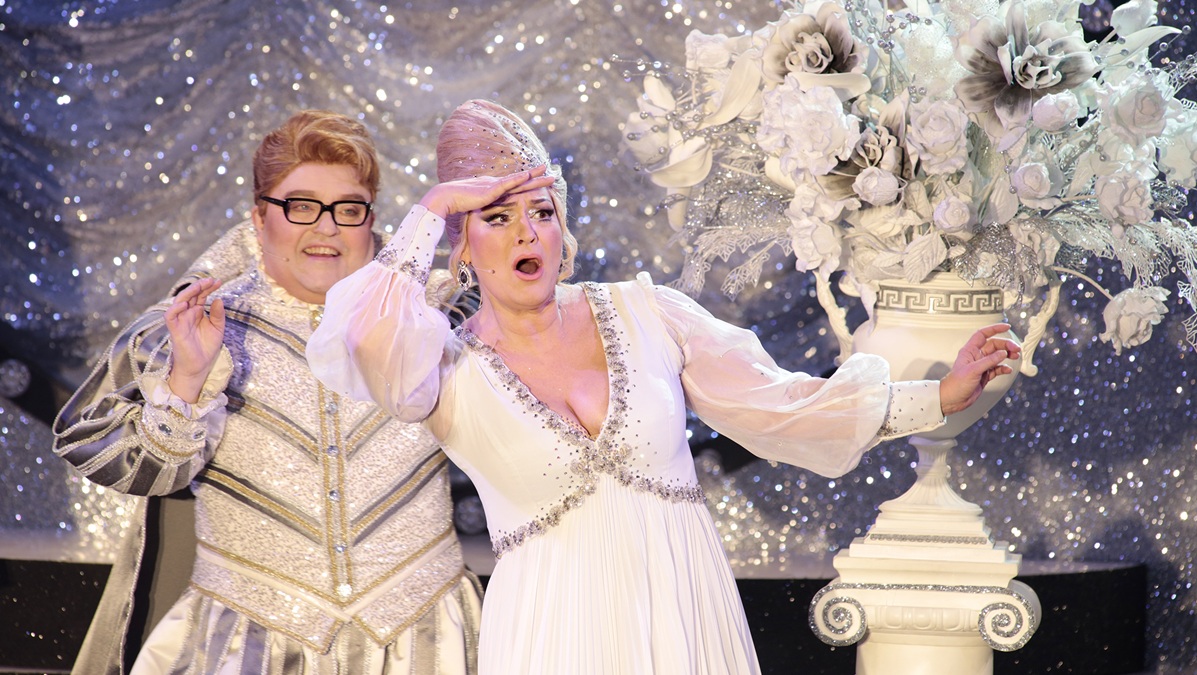
Andreja Schneider as the moon goddess and Gustav Peter Wöhler as Prinz Sternschnuppe in “Frau Luna”. (Photo: Barbara Braun / Tipi am Kanzleramt)
Berlin is teeming with artists ideally suited to this repertoire—Max Raabe has repeatedly proven how brilliantly he can handle Tauber songs. Surely it should not be difficult to demonstrate at Unter den Linden as well that one can be up to date, rather than chasing an operetta ideal that was already problematic fifty years ago. And instead of allowing dramaturg Detlef Giese’s program-note essay, “Franz Lehár or the Ennoblement of Operetta,” to erect a strange monument—complete with the transfiguration of the composer into the heir of Suppé, Strauss, Millöcker, Heuberger, and Ziehrer. We—and the world—could truly have been spared this Nazi nonsense at the turn of the year, along with the babble about “golden” and “silver” operetta while failing to acknowledge how deeply antisemitic this postwar terminology is (read more about this here).
In short: this start to the new year was hardcore—in many ways. But I am nevertheless glad to have experienced it. Because the concert reminded me just how far the operetta world elsewhere has already progressed, and how many more exciting things there are still to discover around this genre.
You can watch the entire concert here: